
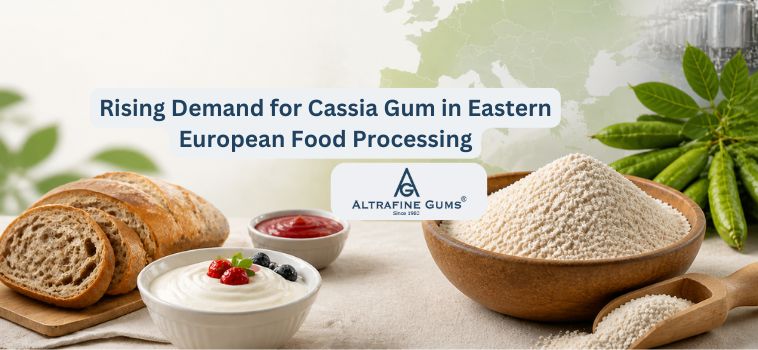
Altrafine Blog

AI Summary

This article explores the rapidly expanding role of cassia gum and cassia gum powder in Eastern European food processing. From its functional advantages over other hydrocolloids to its sustainable sourcing credentials, cassia gum is gaining significant momentum across Poland, Hungary, Romania and beyond. The piece covers health trends, market drivers, competitive comparisons and future growth opportunities – offering a comprehensive view of why cassia tora suppliers and cassia gum manufacturers are increasingly focusing on this dynamic region.

Buy Cassia Gum Direct from Manufacturer
call Call Now

The Growing Demand for Cassia Gum Powder in Eastern Europe’s Food Industry

Eastern Europe’s food processing sector is undergoing a quiet but consequential transformation. As manufacturers across the region seek cleaner, more functional and cost-effective ingredients, cassia gum has emerged as one of the most compelling options in the hydrocolloid space. Derived from the endosperm of Sennaobtusifolia seeds, cassia gum powder delivers powerful thickening and gelling properties that are finding increasing relevance in dairy products, meat processing, bakery applications and convenience foods.

The compound is approved under the European food additive designation E427 cassia gum powder (also referenced as cassia gum powder E427), giving it regulatory standing across EU member states in Eastern Europe. As regional processors look for reliable, approved alternatives to synthetic thickeners, the cassia gum market in this part of the world is seeing sustained year-on-year growth – a trend that shows no sign of slowing.

Cassia Gum vs. Other Hydrocolloids in Eastern European Food Manufacturing

Hydrocolloids are the backbone of modern food texture engineering and Eastern European manufacturers have traditionally leaned on guar gum, xanthan gum and carrageenan to achieve desired consistencies in their products. However, refined cassia gum powder is carving out a distinctive position in this competitive landscape.

Unlike guar gum, which can impart a slightly beany aftertaste at higher concentrations, cassia gum is largely flavour-neutral – a meaningful advantage in delicate applications like flavoured dairy desserts or premium meat emulsions. When compared to xanthan gum, cassia tora powder offers superior gel formation when used in combination with carrageenan or locust bean gum, producing firmer, more stable textures at lower use levels. This synergistic gelling behaviour is particularly prized in the production of pet foods, processed meats and low-fat dairy alternatives – all categories seeing strong growth across Eastern Europe.

From a cost perspective, cassia powder also competes favourably. Eastern European food manufacturers operating on tighter margins find it appealing that cassia gum can replace more expensive hydrocolloids without sacrificing technical performance. The result is a compound that wins not just on functionality, but also on economics.

Health Benefits Driving the Growth of Cassia Gum Powder in Eastern European Food Products

One of the most powerful forces reshaping Eastern European food markets is the health-conscious consumer. Urban populations in Poland, the Czech Republic, Hungary and Romania are increasingly scrutinising ingredient labels – and the shift towards natural, plant-derived additives is clearly reflected in procurement strategies across the food industry.

Cassia gum powder aligns naturally with this demand. As a plant-based polysaccharide with dietary fibre properties, it supports digestive health and can contribute to reduced-fat and reduced-calorie formulations by improving mouthfeel and body without adding significant caloric load. Cassia tora uses extend into functional food development, where its prebiotic potential is attracting interest from manufacturers creating gut-health-oriented product lines.

Furthermore, growing consumer awareness around clean-label certification means that ingredients designated as natural and non-GMO carry a distinct marketing premium. Cassia gum fits this profile well andcassia powder uses are expanding accordingly into organic and health-positioned products – from plant-based dairy alternatives to fortified grain products.
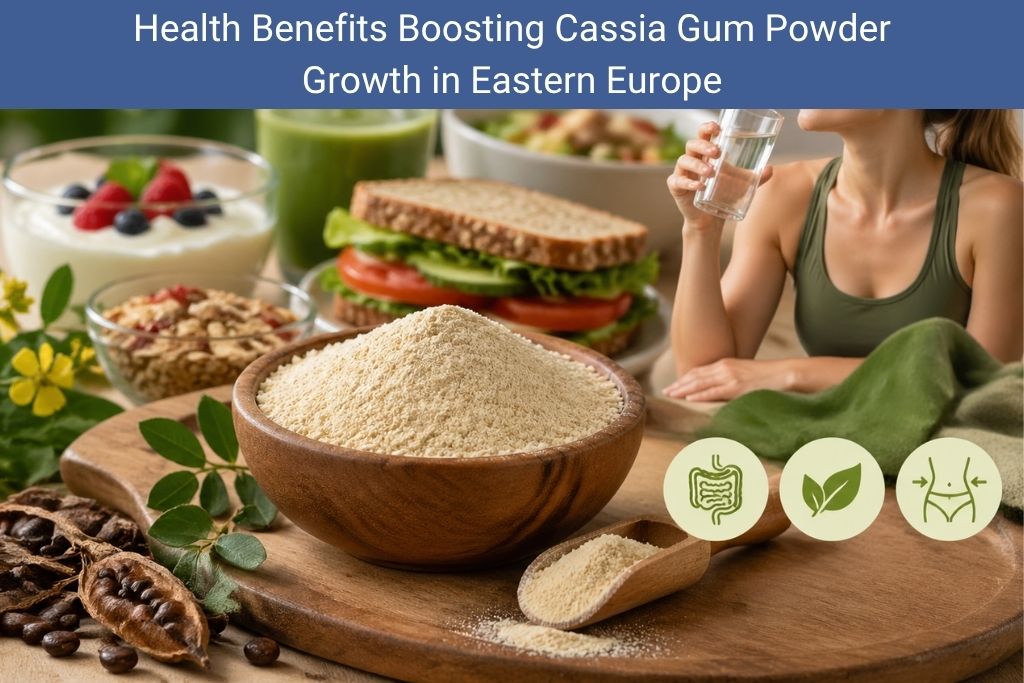
Health Benefits Driving the Growth of Cassia Gum Powder

Sustainability and Cassia Gum Powder: A Growing Trend in Eastern European Food Processing

Sustainability has moved from a corporate talking point to a genuine procurement criterion across Eastern European food manufacturing. As EU environmental directives tighten and consumers hold brands to higher ecological standards, the sourcing story behind each ingredient matters more than ever.

Cassia (Sennaobtusifolia) is a hardy, drought-tolerant crop primarily cultivated in India and parts of East Africa. Its cultivation requires relatively modest water and agrochemical inputs compared to many other hydrocolloid source crops. For manufacturers in the cassia gum market, this translates into a more defensible sustainability narrative – particularly important when pitching to major retail chains or export markets with stringent environmental compliance requirements.

Responsible cassia tora suppliers increasingly provide traceability documentation, third-party certifications and sustainability audit trails that allow Eastern European buyers to meet their own ESG reporting obligations. Cassia gum manufacturers who invest in ethical sourcing and processing transparency are finding particular favour with Polish, German-affiliated and Scandinavian-focused supply chains operating through Eastern European hubs.

Key Countries in Eastern Europe Adopting Cassia Gum Powder for Food Production

While the broader Eastern European region shows promising momentum, certain markets stand out for their pace of cassia gum adoption.

Poland, as the largest food processing economy in Central-Eastern Europe, is a natural leader. Its substantial dairy, meat and confectionery sectors provide broad scope for refined cassia gum powder applications. Polish manufacturers exporting to Western Europe must meet rigorous clean-label and functionality standards, making cassia gum an attractive ingredient upgrade.

Hungary has a well-established tradition in meat and paprika-based processed foods. Here, cassia gum powderis gaining traction as a binder and stabiliser in sausages and pâtés, where its neutral flavour and firm gel properties complement existing formulations without disrupting product identity.

Romania, with its rapidly modernising food processing industry and growing middle-class consumer base, represents one of the highest-growth opportunities in the region. Demand for convenience foods and functional dairy is accelerating and local manufacturers are actively sourcing from cassia tora suppliers to meet new product development briefs.

Other notable markets include the Czech Republic, Slovakia and the Baltic states, where EU regulatory alignment creates a favourable environment for ingredients already carrying E427 approval. In each of these markets, import relationships with Indian cassia gum manufacturers are becoming increasingly formalised.

Request Bulk Pricing
Email EMAIL US NOW

The Future of Cassia Gum in Eastern European Food Processing: Trends and Opportunities

Looking ahead, several converging trends suggest that the cassia gum market in Eastern Europe is positioned for significant expansion.

The rise of plant-based and vegan food products across the region directly benefits cassia gum, as manufacturers require effective gelling agents free from animal-derived components. Similarly, the growth of functional foods – products designed to deliver measurable health outcomes – expands the relevance of cassia tora powder as a fibre-enriching ingredient.

Innovation in hybrid hydrocolloid systems is another frontier of opportunity. Formulators are discovering that blends of cassia gum with other approved gums produce textures unachievable with single-ingredient systems, opening new possibilities in premium segments like artisan cheese alternatives, plant-based meat analogues and structured desserts.

Finally, digital procurement and direct sourcing relationships are shortening supply chains between Eastern European manufacturers and Indian cassia gum manufacturers, reducing costs and improving ingredient traceability. As these commercial relationships mature, cassia powder uses will continue to diversify – potentially extending into nutraceutical, cosmetic and pharmaceutical applications adjacent to food processing.

Conclusion

Cassia gum’s rise in Eastern European food processing reflects the intersection of several powerful forces: the demand for clean-label functionality, cost efficiency, sustainability and health-positive ingredients. As refined cassia gum powder earns its place alongside more established hydrocolloids, the region’s manufacturers are discovering a versatile, well-regulated and commercially attractive ingredient. For cassia tora suppliers and manufacturers worldwide, Eastern Europe represents not just an emerging market – but a maturing one with real long-term depth.

FAQs

What is cassia gum powder used for in food processing?

Cassia gum powder is used as a thickening, gelling and stabilising agent across dairy, meat, bakery and convenience food applications in Eastern Europe and globally.

Is cassia gum powder E427 approved for use in European food products?

Yes, E427 cassia gum powder holds EU food additive approval, making it legally usable across all EU member states including Eastern European countries.

How does cassia tora powder differ from guar gum?

Cassia tora powder forms firmer gels, is flavour-neutral and performs synergistically with other gums, offering advantages over guar gum in several texture-critical applications.

Where can Eastern European manufacturers source refined cassia gum powder?

Most refined cassia gum powder is sourced from established cassia tora suppliers and cassia gum manufacturers based primarily in India, with increasing direct trade relationships to Eastern Europe.

Why is the cassia gum market growing in Eastern Europe specifically?

Clean-label trends, EU regulatory alignment, plant-based food growth and the push for sustainable ingredients are the primary drivers accelerating cassia gum adoption across the Eastern European food sector.

<< 1 >>


AI Summary

This article provides a comprehensive guide to sourcing Fast Hydration Guar Gum Powder, covering its critical role across food, pharmaceutical and cosmetic industries. It examines the key quality parameters-viscosity, purity, moisture content and particle size-that determine hydration speed and end-product performance. Readers will learn how fast hydrating slurriable guar gum improves product consistency, what certifications and sourcing standards to look for, how to evaluate fast hydration guar gum price against performance and strategies to overcome common sourcing challenges like inconsistent hydration or contamination.

Understanding the Importance of Fast Hydration in Guar Gum Powder

In industries where precision and consistency are paramount, Fast Hydration Guar Gum Powder has emerged as a critical ingredient. Unlike standard grades, fast hydration variants are engineered to dissolve and develop viscosity significantly quicker-often within minutes-making them indispensable in time-sensitive manufacturing environments.

Guar Gum is a natural polysaccharide derived from the guar plant (Cyamopsistetragonoloba), primarily grown in India and Pakistan. When processed into Guar Gum Powder, it becomes a highly functional hydrocolloid used as a thickener, binder and stabilizer. The hydration rate-how quickly the powder absorbs water and builds viscosity-directly determines how efficiently it performs in its intended application.

Purity - What's Really in Your Powder

In the food industry, a slow-hydrating gum can disrupt production timelines and cause batch inconsistencies. In pharmaceuticals, delayed hydration may affect tablet coating or drug-release profiles. Cosmetic formulators depend on quick hydration to achieve smooth emulsions and stable lotions. For oil and gas applications, fast hydrating slurriable guar gum allows operators to prepare fracturing fluids on-the-fly, saving time and cost in the field.

Understanding why hydration speed matters is the first step in making a smarter sourcing decision.

Key Factors to Evaluate for High-Quality Fast Hydration Guar Gum

Not all Guar Gum Powder grades are created equal. When evaluating suppliers, procurement professionals should closely examine the following quality parameters:

Purity and Galactomannan Content

The active component in Guar Gum is galactomannan. Premium-grade Guar Gum Powder should contain 75–85% galactomannan content. Higher purity translates to better hydration efficiency, reduced off-flavors and lower dosage requirements.

Moisture Content

Excess moisture accelerates premature hydration and reduces shelf life. Ideal moisture content for Fast Hydration Guar Gum Powder should be below 10–12%. High moisture can cause lumping during storage and slow down controlled hydration in production.

Particle Size Distribution

Finer particle sizes (typically 200 mesh or 75 microns) allow greater surface area exposure to water, dramatically accelerating hydration rates. Always review the particle size distribution (PSD) report from your supplier-uniform distribution prevents clumping and ensures reproducible results.

pH Value and Ash Content

A neutral pH (6.5–7.5) ensures compatibility with a broad range of formulations. Low ash content (below 1.5%) indicates minimal mineral impurities that can interfere with hydration.

How Fast Hydration Guar Gum Powder Impacts End-Product Consistency

The speed and uniformity of hydration have a direct bearing on the quality of the finished product. Whether you are manufacturing salad dressings, ice cream, pharmaceutical tablets or personal care products, the role of a reliable guar gum stabilizer cannot be overstated.

Texture and Mouthfeel

In food and beverage applications, Rapid Viscosity Guar Gum Powder contributes to smooth, stable textures. Fast-hydrating grades ensure that viscosity builds evenly, preventing lumpy or grainy textures in soups, sauces and dairy products. In ice cream, guar gum controls ice crystal formation and improves creaminess.

Stability and Shelf Life

A properly hydrated gum network creates a stable matrix that resists phase separation and syneresis (water separation). Products formulated with high-quality fast hydrating slurriable guar gum maintain their texture and appearance throughout shelf life, reducing costly product recalls and customer complaints.

Processing Efficiency

Fast hydration dramatically reduces mixing times on the production floor. When a guar gum stabilizer hydrates in 3–5 minutes rather than 20–30 minutes, manufacturers can increase batch throughput, reduce energy consumption and improve overall line efficiency.

Uniformity across Batches

Batch-to-batch consistency depends heavily on the hydration behaviour of Guar Gum Powder. If hydration rates vary between shipments, it creates downstream quality issues that are difficult to control. Partnering with suppliers who deliver consistent particle size and viscosity specifications is essential to maintaining uniform end-product quality.

Get Reliable Supply for Your Industry
Email Request Quote

The Role of Sourcing Standards in Fast Hydration Guar Gum Powder

The quality of Fast Hydration Guar Gum Powder is not just determined by chemistry-it is upheld by the sourcing standards, manufacturing practices and certifications maintained by the supplier.

Key Certifications to Look For

  • ISO 9001:2015 – Confirms a quality management system is in place for consistent production.
  • ISO 22000 / FSSC 22000 – Food safety management standard critical for food-grade guar gum.
  • Halal & Kosher Certification – Essential for food and pharmaceutical manufacturers serving specific markets.
  • USDA Organic – Required if sourcing for organic food or cosmetic product lines.
  • Non-GMO Verification – Increasingly demanded by health-conscious consumer brands.
  • REACH / EU Compliance – Mandatory for manufacturers supplying into European markets.

Beyond certifications, buyers should evaluate the supplier’s:

  • Good Manufacturing Practices (GMP) compliance
  • Third-party laboratory testing and Certificate of Analysis (CoA) availability
  • Traceability systems from farm to final product
  • Allergen control and contamination prevention protocols

Reputable suppliers of Fast Hydration Guar Gum Powder will readily provide documentation for all of the above. Transparency in the supply chain is a strong indicator of product reliability.

Cost vs. Performance: Balancing Price and Quality in Fast Hydration Guar Gum

One of the most common dilemmas for procurement teams is evaluating fast hydration guar gum price against real-world performance. A cheaper product that delivers inconsistent hydration can ultimately cost more due to production delays, reformulation costs and product failures.

Understanding Price Drivers

The fast hydration guar gum price is influenced by several factors: raw material (guar split) quality, degree of processing and purification, particle size refinement, certification costs and global supply-demand dynamics. Premium fast hydrating slurriable guar gum commands a higher price because of the additional processing steps involved in achieving narrow particle size distributions and high galactomannan purity.

Total Cost of Ownership

When comparing suppliers, consider the total cost of ownership rather than per-kilogram price alone. A higher-quality Guar Gum Powder that requires less dosage (due to higher galactomannan content) often results in a lower cost per batch. Faster hydration also means reduced mixing time and energy-savings that add up significantly in large-scale manufacturing.

Requesting Samples and Conducting Trials

Before committing to a large order, always request samples from shortlisted suppliers. Conduct side-by-side hydration trials at your facility under actual production conditions. Measure viscosity build-up over time and compare results against your specification sheet. This step is non-negotiable for high-volume buyers.

Long-Term Supplier Relationships

Building long-term relationships with certified suppliers of Fast Hydration Guar Gum Powder typically results in more stable pricing, priority access to stock during supply disruptions and better quality assurance support. Volume commitments often unlock better unit economics without sacrificing quality.

Cost vs. Performance: Fast Hydration Guar Gum

Common Challenges When Sourcing Fast Hydration Guar Gum and How to Overcome Them

Even experienced procurement teams encounter challenges when sourcing Guar Gum Powder. Awareness of these issues-and proactive mitigation strategies-can protect your supply chain and product quality.

Challenge 1: Inconsistent Hydration Speed across Batches

Variability in particle size, moisture content orgalactomannan levels from batch to batch can cause significant process disruptions.

Solution: Require suppliers to provide a Certificate of Analysis (CoA) for every batch and conduct incoming quality control (IQC) checks on viscosity and moisture upon receipt.

Challenge 2: Contamination and Microbiological Issues

Guar gum, being a natural product, is susceptible to microbial contamination if not processed and stored correctly.

Solution: Only source from suppliers with documented GMP compliance, microbial testing protocols and proper packaging for moisture control (typically triple-layer, moisture-barrier bags).

Challenge 3: Supply Chain Disruptions

Guar is a seasonal crop and supply disruptions-due to drought, harvest failures or export restrictions-can lead to price spikes and shortages.

Solution: Maintain 60–90 days of safety stock and develop relationships with multiple certified suppliers to avoid single-source dependency.

Challenge 4: Counterfeit or Adulterated Products

The market occasionally sees Fast Hydration Guar Gum Powder adulterated with starch, cellulose derivatives or low-grade gum to reduce costs.

Solution: Perform periodic third-party laboratory testing (FTIR analysis, galactomannan content assay) to verify the authenticity of your guar gum supply.

Challenge 5: Regulatory Non-Compliance

Products destined for food, pharmaceutical or cosmetic applications must comply with regional regulations (FDA, EFSA, etc.).

Solution: Always verify that your supplier’s Guar Gum Powder is manufactured and tested to the applicable regulatory standard for your end market before procurement.

Trusted Supplier of Guar Gum with Wide Industry Applications
call Contact Us

Conclusion

Sourcing the right Fast Hydration Guar Gum Powder requires a multi-dimensional evaluation process that goes well beyond comparing the fast hydration guar gum price alone. From understanding the science of hydration to scrutinising supplier certifications, conducting performance trials and building resilient supply chains, every step matters.

The ideal supplier of Guar Gum Powder combines technical expertise, rigorous quality standards and transparent supply chain practices. Whether you require a guar gum stabilizer for food manufacturing, a fast hydrating slurriable guar gum for industrial applications or a high-purity grade for pharmaceutical use, your sourcing decision will have a direct impact on the quality and consistency of your end products.

By applying the criteria outlined in this guide, procurement professionals can make informed, confident decisions that deliver both performance and value-ensuring that your supply of Fast Hydration Guar Gum Powder remains a competitive advantage rather than a liability.

FAQs

What makes Fast Hydration Guar Gum Powder different from standard guar gum?

Fast Hydration Guar Gum Powder is processed to finer particle sizes with higher galactomannan purity, enabling it to dissolve and build viscosity significantly faster than standard grades.

What is fast hydrating slurriable guar gum used for?

Fast hydrating slurriable guar gum is widely used in oil and gas hydraulic fracturing, where it must hydrate rapidly when mixed with water at the well site to form fracturing fluids.

How does fast hydration guar gum price compare to standard grades?

Fast hydration guar gum price is generally 15–30% higher than standard grades due to the additional refining processes, but the performance gains and lower dosage requirements often offset the premium.

Which certifications are most important when sourcing guar gum for food applications?

ISO 22000, FSSC 22000, Halal and Kosher certifications are the most critical for food-grade Guar Gum Powder, ensuring safety and compliance across global markets.

How can I verify the quality of Guar Gum Powder before placing a large order?

Request product samples, conduct in-house hydration trials and review the supplier's Certificate of Analysis, third-party lab reports and batch consistency records before committing.

<< 1 >>


AI SUMMARY

Guar gum powder quality is governed by 18 critical parameters – from viscosity and moisture content to microbial safety and shelf life. This comprehensive guide helps buyers, formulators and procurement teams understand what separates a premium batch from a substandard one. Whether you’re sourcing from a guar gum powder manufacturer, comparing guar gum price points or evaluating a guar gum exporter, these parameters are the definitive checklist for quality assurance across food, pharmaceutical and industrial applications.

Guar Gum Powder: Quality Parameters That Define a Premium Batch

In the world of hydrocolloids, few ingredients command as much commercial importance as guar gum. Derived from the endosperm of the guar bean, guar gum powder has become indispensable across food processing, oil drilling, pharmaceuticals, textiles and paper manufacturing. As global demand intensifies, the role of the guar gum powder manufacturer, guar gum exporter and guar gum suppliers in delivering consistent, high-quality product has never been more critical.

But what exactly separates a premium batch from a mediocre one? The answer lies in 18 measurable, verifiable quality parameters. Whether you are a procurement manager, food technologist or industrial buyer comparing guar gum price across suppliers, this guide delivers the technical foundation you need.

Looking for Food-Grade Guar Gum Powder?
call Contact Us

1. Viscosity – The Master Parameter

Viscosity is the single most important quality indicator for guar gum. It measures a solution’s resistance to flow when guar gum is hydrated, typically expressed in centipoise (cP) at a 1% concentration. High-viscosity grades – ranging from 5,000 to 7,000 cP or beyond – are preferred for applications demanding a powerful guar gum thickening agent, such as oil well fracturing fluids and food sauces. Lower viscosity grades suit applications requiring lighter body, such as certain beverages or cosmetic emulsions. A reliable guar gum powder exporter will always declare viscosity values with the testing method and concentration used.

2. Moisture Content – Protecting Shelf Life

Moisture content, ideally maintained below 12%, is directly tied to shelf life stability. Excess moisture accelerates microbial growth, causes powder caking and degrades the polymer chains responsible for viscosity. Guar gum suppliers operating under ISO or food-grade certifications conduct routine moisture analysis using oven-drying or Karl Fischer titration methods. Buyers sourcing guar gum for long-haul export should prioritize manufacturers who pack in moisture-resistant multi-layer bags with desiccants.

3. Purity – What’s Really in Your Powder

Purity in guar gum powder refers to the galactomannan content – the active polysaccharide responsible for all functional properties. Premium-grade powder contains 75–85% galactomannan. Lower purity grades contain higher levels of psyllium husk fiber, protein and insoluble residue, reducing functional performance. Industrial grade guar gum used in mining, paper or explosives manufacturing may tolerate lower purity, but food and pharmaceutical grades demand strict thresholds. Buyers evaluating guar gum price should factor purity-adjusted performance into their cost calculations rather than comparing raw price alone.

Purity - What's Really in Your Powder

4. Particle Size Distribution – Consistency in Every Batch

Particle size distribution (PSD) determines how uniformly the powder disperses and hydrates in solution. Finely milled powder (100–200 mesh) hydrates faster, while coarser grades dissolve more slowly, reducing lump formation during high-shear mixing. Food and pharmaceutical applications requiring smooth textures demand tight PSD specifications. A skilled guar gum powder manufacturer uses laser diffraction or sieve analysis to confirm PSD compliance before dispatch. Inconsistent particle size is one of the leading causes of batch-to-batch performance variation.

5. Ash Content – Measuring Mineral Residue

Ash content measures the inorganic mineral residue remaining after combustion – an indicator of processing cleanliness and purity. High ash content signals excessive soil, mineral contamination or inadequate processing. Food-grade specifications typically require ash content below 1.5%, while some pharmaceutical applications demand even lower thresholds. When comparing guar gum suppliers, ash content data is a silent but revealing quality marker.

6. Color and Appearance – Visual Quality Assurance

Premium guar gum powder presents as a free-flowing, off-white to cream-colored powder with a uniform appearance. Discoloration – yellowing, grayish tones or visible specks – indicates oxidation, heat damage during processing or microbial activity. While color alone does not determine functionality, it directly reflects processing hygiene and raw material quality. Color meters (CIE Lab values) provide objective color measurement used by leading guar gum exporters in quality certificates.

7. Protein Content – A Functional but Double-Edged Parameter

Guar gum naturally contains 4–6% protein. In food applications, residual protein may contribute to allergen concerns or undesirable Maillard browning during heat processing. In fermentation media, protein content can be beneficial. Industrial grade guar gum used in oil drilling or paper manufacturing is less sensitive to protein levels. Guar gum powder manufacturers serving food and pharma clients typically include protein content in their technical data sheets.

Protein Content: A Key Factor with Pros and Cons

8. pH Level – Ensuring Formulation Compatibility

The pH of a 1% guar gum solution typically ranges from 5.5 to 7.5. Extreme pH deviations signal contamination, degradation or processing anomalies. As a guar gum stabilizer in dairy products, dressings or pharmaceutical suspensions, pH compatibility with the final formulation is non-negotiable. Most guar gum suppliers report pH on batch certificates and buyers should request this data proactively.

9. Solubility – From Powder to Function

Solubility determines how completely and efficiently the powder disperses in water at ambient or elevated temperatures. Cold-water-soluble grades are essential in ready-to-use food applications, while hot-water-soluble grades suit industrial processes. Poor solubility – resulting in insoluble residues or lumps – compromises end-product texture and process efficiency. Guar gum’s solubility is tested via filtration residue or turbidity measurements and is a key specification requested by food and beverage manufacturers.

10. Gel Strength – Texture Defining Performance

Gel strength describes guar gum’s ability to form a cohesive, elastic network in solution. While guar gum is not a true gelling agent (unlike xanthan or carrageenan), its gel-like viscosity under certain conditions is critical for oil field fracturing, bakery products and pharmaceutical tablet coatings. Gel strength is measured by texture analyzers and rheometers. High gel strength grades from certified guar gum powder exporters command premium pricing in specialized markets.

11. Microbial Contamination – Non-Negotiable Safety

Food-grade and pharmaceutical-grade guar gum must meet strict microbiological standards, including limits on Total Plate Count (TPC), Yeast &Mold, Coliforms, Salmonella and E. coli. Microbial contamination originates from raw bean handling, drying or unhygienic processing environments. Buyers must demand certificates of analysis (CoA) with microbial test results from every lot. A reputable guar gum powder manufacturer conducts in-process and finished-product microbiological testing aligned with Food Chemical Codex (FCC) or BP/USP pharmacopeia standards.

12. Bulk Density – Handling and Storage Efficiency

Bulk density (typically 500–800 g/L for guar gum powder) affects packaging volumes, conveying efficiency and storage space requirements. Lower bulk density grades are fluffier and more prone to dusting, while denser grades pack more compactly. Buyers procuring large volumes from guar gum suppliers should factor bulk density into freight and warehousing cost calculations.

13. Water Holding Capacity – Moisture Management

Water holding capacity (WHC) measures how much water a given mass of guar gum can absorb and retain. High WHC is desirable in bakery, meat processing and gluten-free food applications where moisture retention improves texture and extends freshness. Industrial grade guar gum powderused in construction or paper benefits from controlled WHC as well. This parameter is measured gravimetrically and is increasingly requested by food technology teams.

Multi-Industry Gum Powder Solutions
Email Email Us Now!

14. Viscosity Stability – Performance over Time

Viscosity stability measures how well a guar gum solution maintains its original viscosity over time, under varying temperature, pH and shear conditions. Unstable viscosity – common in lower-quality or degraded batches – leads to inconsistent end-product texture and process failures. A guar gum stabilizer used in salad dressings or ice creams must maintain viscosity through multiple freeze-thaw cycles. Leading guar gum exporters provide aging study data to demonstrate long-term viscosity stability.

15. Temperature Sensitivity – Performance under Heat

Guar gum viscosity decreases significantly at elevated temperatures (above 80°C) and recovers partially upon cooling. Applications involving hot processing – soups, sauces, retorted foods – require grades with superior temperature stability. Formulators should test viscosity profiles across the intended processing temperature range. Guar gum powder manufacturers catering to food processors often provide temperature-viscosity curve data in its technical documentation.

16. Residual Solvents – A Purity Concern

During processing and chemical modification, solvents including isopropanol or acetone may be introduced. Residual solvent levels must comply with ICH Q3C guidelines for pharmaceutical applications or food safety regulations for food-grade products. Guar gum suppliers should provide solvent residue testing data upon request, particularly for pharmaceutical-grade batches.

17. Particle Shape – Processing Efficiency

Beyond particle size, particle shape – whether angular, rounded or irregular – influences flow behavior, blending uniformity and hydration kinetics. Spherical or near-spherical particles exhibit superior flowability and consistent packing density. Advanced guar gum powder manufacturers use scanning electron microscopy (SEM) for particle morphology analysis in R&D and quality development programs.

18. Shelf Life and Storage Best Practices

Under optimal conditions – cool (below 25°C), dry (relative humidity below 65%) and away from direct sunlight –high-quality guar gum powder retains functional properties for 24 months or beyond. Storage in opened bags requires immediate resealing to prevent moisture ingress. Guar gum suppliers serving markets in tropical or high-humidity regions should recommend climate-controlled warehousing. Batch dating and FIFO (First In, First Out) inventory management are essential practices for maintaining quality integrity.

Conclusion

The 18 parameters outlined above form the complete quality blueprint for evaluating guar gum powder – from sourcing decisions to formulation development. Whether you are assessing guar gum price competitiveness, qualifying a new guar gum exporter or benchmarking your existing guar gum suppliers, these parameters deliver measurable, objective standards.

In a market where quality variance is significant, buyers and formulators who understand viscosity, purity, microbial safety and stability data are better positioned to make procurement decisions that optimize both cost and performance. Partnering with an experienced guar gum powder manufacturer who provides comprehensive, certificate-backed quality data is not just best practice – it is a competitive advantage.

FAQs

What viscosity grade of guar gum should I choose for food applications?

For most food applications, a viscosity of 3,500–5,500 cP (1% solution) is suitable; higher grades are recommended for thickening-intensive uses like sauces and dressings.

How does moisture content affect guar gum powder quality during shipping?

Moisture above 12% promotes microbial growth and caking; buyers should ensure multi-layer moisture-resistant packaging and request moisture content on the certificate of analysis.

What is the difference between food-grade and industrial grade guar gum?

Food-grade guar gum meets strict microbiological and purity standards (FCC/BP); industrial grade guar gum tolerates wider purity ranges suitable for paper, oil field and construction applications.

How do I evaluate a guar gum exporter's reliability beyond price?

Request certificates of analysis covering all 18 quality parameters, check third-party audit certifications and ask for viscosity stability and aging study data from the supplier.

Can guar gum powder be stored for more than two years?

Yes, under optimal conditions (below 25°C, below 65% RH, sealed packaging), premium guar gum powder retains full functional properties for 24–30 months from manufacturing date.

<< 1 >>


Rising Demand Cassia Gum Eastern European Food Processing

AI Summary

This article explores the rapidly expanding role of cassia gum and cassia gum powder in Eastern European food processing. From its functional advantages over other hydrocolloids to its sustainable sourcing credentials, cassia gum is gaining significant momentum across Poland, Hungary, Romania and beyond. The piece covers health trends, market drivers, competitive comparisons and future growth opportunities – offering a comprehensive view of why cassia tora suppliers and cassia gum manufacturers are increasingly focusing on this dynamic region.

The Growing Demand for Cassia Gum Powder in Eastern Europe’s Food Industry

Eastern Europe’s food processing sector is undergoing a quiet but consequential transformation. As manufacturers across the region seek cleaner, more functional and cost-effective ingredients, cassia gum has emerged as one of the most compelling options in the hydrocolloid space. Derived from the endosperm of Senna obtusifolia seeds, cassia gum powder delivers powerful thickening and gelling properties that are finding increasing relevance in dairy products, meat processing, bakery applications and convenience foods.

The compound is approved under the European food additive designation E427 cassia gum powder (also referenced as cassia gum powder E427), giving it regulatory standing across EU member states in Eastern Europe. As regional processors look for reliable, approved alternatives to synthetic thickeners, the cassia gum market in this part of the world is seeing sustained year-on-year growth – a trend that shows no sign of slowing.

Need More Information?
Email Email Us Today!

Cassia Gum vs. Other Hydrocolloids in Eastern European Food Manufacturing

Hydrocolloids are the backbone of modern food texture engineering and Eastern European manufacturers have traditionally leaned on guar gum, xanthan gum and carrageenan to achieve desired consistencies in their products. However, refined cassia gum powder is carving out a distinctive position in this competitive landscape.

Unlike guar gum, which can impart a slightly beany aftertaste at higher concentrations, cassia gum is largely flavour-neutral – a meaningful advantage in delicate applications like flavoured dairy desserts or premium meat emulsions. When compared to xanthan gum, cassia tora powder offers superior gel formation when used in combination with carrageenan or locust bean gum, producing firmer, more stable textures at lower use levels. This synergistic gelling behaviour is particularly prized in the production of pet foods, processed meats and low-fat dairy alternatives – all categories seeing strong growth across Eastern Europe.

From a cost perspective, cassia powder also competes favourably. Eastern European food manufacturers operating on tighter margins find it appealing that cassia gum can replace more expensive hydrocolloids without sacrificing technical performance. The result is a compound that wins not just on functionality, but also on economics.

Health Benefits Driving the Growth of Cassia Gum Powder in Eastern European Food Products

One of the most powerful forces reshaping Eastern European food markets is the health-conscious consumer. Urban populations in Poland, the Czech Republic, Hungary and Romania are increasingly scrutinising ingredient labels – and the shift towards natural, plant-derived additives is clearly reflected in procurement strategies across the food industry.

Cassia gum powder aligns naturally with this demand. As a plant-based polysaccharide with dietary fibre properties, it supports digestive health and can contribute to reduced-fat and reduced-calorie formulations by improving mouthfeel and body without adding significant caloric load. Cassia tora uses extend into functional food development, where its prebiotic potential is attracting interest from manufacturers creating gut-health-oriented product lines.

Furthermore, growing consumer awareness around clean-label certification means that ingredients designated as natural and non-GMO carry a distinct marketing premium. Cassia gum fits this profile well and cassia powder uses are expanding accordingly into organic and health-positioned products – from plant-based dairy alternatives to fortified grain products.

Health Benefits Boosting Cassia Gum Powder Growth Eastern Europe

Sustainability and Cassia Gum Powder: A Growing Trend in Eastern European Food Processing

Sustainability has moved from a corporate talking point to a genuine procurement criterion across Eastern European food manufacturing. As EU environmental directives tighten and consumers hold brands to higher ecological standards, the sourcing story behind each ingredient matters more than ever.

Cassia (Senna obtusifolia) is a hardy, drought-tolerant crop primarily cultivated in India and parts of East Africa. Its cultivation requires relatively modest water and agrochemical inputs compared to many other hydrocolloid source crops. For manufacturers in the cassia gum market, this translates into a more defensible sustainability narrative – particularly important when pitching to major retail chains or export markets with stringent environmental compliance requirements.

Responsible cassia tora suppliers increasingly provide traceability documentation, third-party certifications and sustainability audit trails that allow Eastern European buyers to meet their own ESG reporting obligations. Cassia gum manufacturers who invest in ethical sourcing and processing transparency are finding particular favour with Polish, German-affiliated and Scandinavian-focused supply chains operating through Eastern European hubs.

Key Countries in Eastern Europe Adopting Cassia Gum Powder for Food Production

While the broader Eastern European region shows promising momentum, certain markets stand out for their pace of cassia gum adoption.

Poland, as the largest food processing economy in Central-Eastern Europe, is a natural leader. Its substantial dairy, meat and confectionery sectors provide broad scope for refined cassia gum powder applications. Polish manufacturers exporting to Western Europe must meet rigorous clean-label and functionality standards, making cassia gum an attractive ingredient upgrade.

Hungary has a well-established tradition in meat and paprika-based processed foods. Here, cassia gum powder is gaining traction as a binder and stabiliser in sausages and pâtés, where its neutral flavour and firm gel properties complement existing formulations without disrupting product identity.

Romania, with its rapidly modernising food processing industry and growing middle-class consumer base, represents one of the highest-growth opportunities in the region. Demand for convenience foods and functional dairy is accelerating and local manufacturers are actively sourcing from cassia tora suppliers to meet new product development briefs.

Other notable markets include the Czech Republic, Slovakia and the Baltic states, where EU regulatory alignment creates a favourable environment for ingredients already carrying E427 approval. In each of these markets, import relationships with Indian cassia gum manufacturers are becoming increasingly formalised.

The Future of Cassia Gum in Eastern European Food Processing: Trends and Opportunities

Looking ahead, several converging trends suggest that the cassia gum market in Eastern Europe is positioned for significant expansion.

The rise of plant-based and vegan food products across the region directly benefits cassia gum, as manufacturers require effective gelling agents free from animal-derived components. Similarly, the growth of functional foods – products designed to deliver measurable health outcomes – expands the relevance of cassia tora powder as a fibre-enriching ingredient.

Innovation in hybrid hydrocolloid systems is another frontier of opportunity. Formulators are discovering that blends of cassia gum with other approved gums produce textures unachievable with single-ingredient systems, opening new possibilities in premium segments like artisan cheese alternatives, plant-based meat analogues and structured desserts.

Finally, digital procurement and direct sourcing relationships are shortening supply chains between Eastern European manufacturers and Indian cassia gum manufacturers, reducing costs and improving ingredient traceability. As these commercial relationships mature, cassia powder uses will continue to diversify – potentially extending into nutraceutical, cosmetic and pharmaceutical applications adjacent to food processing.

Speak with an Expert
call Call Us Now!

Conclusion

Cassia gum’s rise in Eastern European food processing reflects the intersection of several powerful forces: the demand for clean-label functionality, cost efficiency, sustainability and health-positive ingredients. As refined cassia gum powder earns its place alongside more established hydrocolloids, the region’s manufacturers are discovering a versatile, well-regulated and commercially attractive ingredient. For cassia tora suppliers and manufacturers worldwide, Eastern Europe represents not just an emerging market – but a maturing one with real long-term depth.

Our Other Product

Guar Gum Powder

FAQs on Cassia Gum Powder

What is cassia gum powder used for in food processing?

Cassia gum powder is used as a thickening, gelling and stabilising agent across dairy, meat, bakery and convenience food applications in Eastern Europe and globally.

Is cassia gum powder E427 approved for use in European food products?

Yes, E427 cassia gum powder holds EU food additive approval, making it legally usable across all EU member states including Eastern European countries.

How does cassia tora powder differ from guar gum?

Cassia tora powder forms firmer gels, is flavour-neutral and performs synergistically with other gums, offering advantages over guar gum in several texture-critical applications.

Where can Eastern European manufacturers source refined cassia gum powder?

Most refined cassia gum powder is sourced from established cassia tora suppliers and cassia gum manufacturers based primarily in India, with increasing direct trade relationships to Eastern Europe.

Why is the cassia gum market growing in Eastern Europe specifically?

Clean-label trends, EU regulatory alignment, plant-based food growth and the push for sustainable ingredients are the primary drivers accelerating cassia gum adoption across the Eastern European food sector.

<< 1 >>


Altrafine Blog