
Altrafine Blog

Choosing Reliable Fast Hydration Guar Gum Supplier

AI Summary

Fast hydration guar gum is a specially processed polysaccharide that dissolves and builds viscosity rapidly, making it indispensable across food processing, pharmaceuticals, oil & gas and paper manufacturing. Choosing the right Fast Hydration Guar Gum Supplier requires scrutiny of product certifications, consistency in hydration speed and flexibility in bulk sourcing. Fast Hydrating Slurriable Guar formats further simplify handling in slurry-based industrial operations. Buyers must assess total cost-effectiveness beyond unit price – factoring in lead time, minimum order quantities and technical support. This checklist equips procurement teams with a structured framework to vet suppliers and secure the most reliable Fast Hydration Guar Gum Powder for their specific application needs.

Understanding the Importance of Fast Hydration Guar Gum

Guar gum is derived from the endosperm of guar beans and functions as a natural thickener, stabilizer and gelling agent. What distinguishes premium grades is their hydration speed – how quickly the powder absorbs water and achieves full viscosity. This characteristic, known as Fast Hydration Guar Gum, is a critical performance metric, not merely a marketing term.

In food manufacturing, rapid viscosity development means uniform texture in sauces, dairy products and bakery items without extended mixing times. In pharmaceuticals, it ensures consistent drug release profiles in tablet formulations and oral suspensions. In oilfield stimulation, where hydraulic fracturing demands instant gel formation, any delay translates directly into operational inefficiency and cost overruns.

Industrial paper and textile manufacturers similarly depend on fast hydration to maintain throughput. Standard guar gum grades typically require 60–120 minutes to hydrate fully; fast hydration variants achieve target viscosity in under 5 minutes, sometimes less. This gap has significant downstream consequences on energy consumption, batch cycle time and end-product quality.
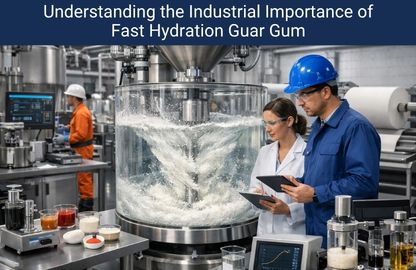
Understanding Industrial Importance Fast Hydration Guar Gum

Key Qualities to Look for in a Fast Hydration Guar Gum Supplier

Supplier selection is not simply about price. The right supplier must demonstrate competence across several dimensions:

  • Product Consistency: Viscosity readings, particle size distribution and moisture content should remain within tight tolerances across batches. Request batch-level certificates of analysis (CoAs) before committing to long-term contracts.
  • Manufacturing Infrastructure: Suppliers operating ISO-certified processing units with modern milling and sieving equipment are more likely to deliver reproducible fast hydration characteristics.
  • Traceability: From raw guar split to finish Fast Hydration Guar Gum Powder, a supplier should maintain complete supply chain transparency and be willing to share it.

Reputation within industry networks, customer references from comparable end-use sectors and on-time delivery track records are equally important qualitative indicators.

Want to Discuss?
call Call Us Now!

Fast Hydrating Slurriable Guar: Testing and Certifications to Ensure Quality

Fast Hydrating Slurriable Guar is designed for direct addition into water-based slurries without pre-blending or premixing – a critical feature in drilling fluids and hydraulic fracturing operations. Verifying quality requires both certified documentation and hands-on testing.

Essential Certifications to Verify:

  • ISO 9001:2015 – Quality management systems certification, confirming process control and traceability.
  • API Standards Compliance – For oilfield-grade Fast Hydrating Slurriable Guar Gum, verify adherence to American Petroleum Institute specifications.

Testing Parameters to Request:

  • Brookfield and Fann Viscosity – A key performance benchmark for hydration speed.
  • Residue on Sieve (mesh 200) – Indicates particle uniformity; finer mesh typically correlates with faster hydration.
  • Moisture Content (typically < 10%) – Excess moisture compromises powder flow and shelf life.
  • pH Value – Stability indicator across application environments.

Request third-party lab reports, not just in-house data. Independent verification from accredited laboratories significantly reduces the risk of misrepresentation.

Our Other Product

Guar Gum Powder

Fast Hydration Guar Gum Powder: Custom Sourcing and Bulk Order Options

Procurement flexibility is a competitive differentiator for suppliers. When sourcing Fast Hydration Guar Gum Powder at scale, evaluate suppliers on the following:

Custom Formulation Capabilities:

Not all applications require identical hydration speeds. Some end-users need 3-minute hydration; others require controlled slow-fast profiles for staged gel formation. A capable supplier will offer custom mesh sizes (100 and 200 mesh), blended formulations with additives like borax for cross-linking and tailored viscosity grades.

Packaging Options:

  • Small pack: 25 kg HDPE Paper laminated Bags (standard for lab-scale and small batch operations)
  • Bulk pack: 500 kg to 1 MT jumbo bags (flexible intermediate bulk containers)

Fast Hydrating Slurriable Guar Gum Powder: Comparing Prices and Cost-Effectiveness

Price of Fast Hydrating Slurriable Guar Gum is nuanced. List price per metric ton is only one variable in total cost-of-ownership calculations.

Factors That Affect True Cost:

  • Viscosity Yield: Higher-viscosity powders require less product per batch. A 7,500 cP grade at a slight premium may outperform a cheaper 5,000 cP grade when total product usage per batch is factored in.
  • Consistency: Inconsistent batches generate rework and waste. A reliable supplier with tight quality specifications often justifies a price premium over cheaper alternatives with high variance.
  • Freight and Lead Time: CIF pricing models versus FOB pricing at origin significantly impact landed cost. Consolidate shipments where possible to reduce per-ton freight.

How to Structure a Price Comparison:

Create a weighted scorecard assigning percentage weights to price, quality consistency, lead time, certifications and technical support. This prevents over-indexing on unit cost and reveals the true best-value for your specific application context.

Need More Information?
Email Email Us Today!

Conclusion

Selecting the right Fast Hydration Guar Gum Supplier is a strategic procurement decision that extends well beyond price negotiation. Fast Hydrating Guar Gum directly impacts process efficiency, end-product quality and operational costs across industries. A structured, scorecard-based approach to supplier assessment eliminates guesswork and mitigates supply chain risk. The right partner will not only deliver consistent Fast Hydrating Slurriable Guar Gum Powder but will also provide support, scalable supply options and transparent quality documentation that sustain long-term operational excellence.

Our Other Product

Cassia Tora Powder

FAQs on Fast Hydration Guar Gum

What is the ideal hydration time for Fast Hydration Guar Gum Powder in food applications?

Most fast hydration guar variants achieve target viscosity within 3–5 minutes at room temperature, compared to 60–120 minutes for standard grades.

Is Fast Hydrating Slurriable Guar the same as regular guar gum powder?

No - slurriable grades are specifically milled and surface-treated to prevent lump formation when added directly to water-based slurries.

How do I verify a supplier's Fast Hydration Guar Gum quality without visiting their facility?

Request third-party lab reports, batch CoAs and trial samples tested against your viscosity benchmark before placing a full order.

Can Fast Hydration Guar Gum Powder be used in cold water processing?

Yes, most fast hydration grades are designed to hydrate effectively in water (25°C), making them suitable for ambient-temperature manufacturing lines.

What is the typical shelf life of Fast Hydrating Slurriable Guar Gum Powder?

When stored in cool, dry conditions below 25°C with moisture content under 12%, shelf life is typically 12–24 months from production date.

<< 1 >>


Cassia Gum Market Trends & Forecast (2026–2030

AI Summary

The global Cassia Gum market is on a steady growth trajectory through 2030, driven by expanding applications across food processing, pharmaceuticals, personal care and animal feed industries. Asia-Pacific dominates both production and consumption, while North America and Europe register consistent import demand. Despite its positive outlook, the market must navigate price volatility, raw material supply challenges and evolving regulatory standards. Technological improvements in refining Cassia Tora Powder into high-purity Refined Cassia Gum Powder are expanding the ingredient’s suitability in premium applications, reinforcing long-term market confidence.

Quick, Hassle-Free Quote
call Call Now!

Cassia Gum Market Growth Projections for 2026-2030

The global Cassia Gum market is projected to grow at a CAGR of approximately 5.8–6.5% between 2026 and 2030, building on a historical valuation in 2024. By the close of 2030, the market may anticipated to surpass millions, reflecting deepening demand across multiple end-use industries.

Historically, demand for Cassia Gum Powder has been concentrated in Europe and North America, where food-grade regulations have been well-established for decades. However, the growth story through 2030 will be shaped significantly by Asia-Pacific, particularly India-the world’s largest producer of Cassia Tora Powder-along with China and Southeast Asian nations expanding their food processing and export capacities.

Latin America and the Middle East & Africa are emerging as secondary growth zones, driven by increasing food industrialization and growing awareness of natural hydrocolloid ingredients. Regional trade policies, raw material availability and evolving local food standards will play a decisive role in shaping market shares across these territories.

Factors Driving Global Demand for Cassia Gum

The demand for Cassia Gum is fundamentally tied to the clean-label movement in the food industry. As manufacturers reformulate products to eliminate synthetic additives, Cassia Gum Powder E427 has emerged as a preferred natural thickener, gelling agent and stabilizer-particularly in pet food, dairy analogs and processed meats.

Beyond food, several emerging applications are reinforcing market adoption. In pharmaceuticals, refined grades of Cassia Gum function as binders and controlled-release excipients. In personal care, the ingredient serves as a natural rheology modifier in skin creams and hair conditioners. The feed additive segment, where Cassia Powder improves pellet binding and moisture retention in aquaculture and livestock feeds, is also registering notable uptick.

On the production side, advances in seed processing technology-including improved dehulling, enzymatic refining and particle size reduction-have significantly enhanced the purity and consistency of Refined Cassia Gum Powder. These improvements reduce batch-to-batch variation, a key concern for industrial buyers and widen the ingredient’s compatibility with sensitive applications such as infant nutrition and pharmaceutical formulation.

Regional Cassia Gum Market Analysis: Key Trends in 2026–2030

North America holds a mature but stable share of the Cassia Gum market, with demand largely concentrated in pet food manufacturing and specialty food processing. Regulatory recognition of E427 Cassia Gum Powder in select applications supports consistent import activity, particularly from Indian suppliers.

Europe remains the most regulated and discerning market. The European Food Safety Authority (EFSA) periodically re-evaluates permitted hydrocolloids and Cassia Gum Powder E427’s status as an EU-approved additive (E427) gives it a competitive edge over less-regulated alternatives. Growth here is incremental but sustained.

Cassia Gum Market by Region: Key Trends 2026–2030

Asia-Pacific dominates the supply side and is fast developing as a strong demand center. India may produces roughly 70–75% of the world’s Cassia Tora Powder, with major processing hubs in Gujarat and Rajasthan. Domestic consumption is climbing as Indian food, feed and cosmetic companies increasingly incorporate Cassia Gum into formulations.

Latin America is emerging as a growth hotspot, with Brazil and Mexico leading demand from the meat processing and pet food sectors. The Middle East & Africa, while still nascent, shows promise through expanding processed food markets and import-oriented trade.

Our Other Product

Guar Gum Powder

Emerging Applications of Cassia Gum in Food, Pharmaceuticals and More

Food & Beverage: Cassia Gum’s synergistic interaction with carrageenan and xanthan gum makes it indispensable in pet food gel formation. In human food, its application is growing in dairy desserts, bakery fillings and sauces as a cost of cassia gum-effective stabilizer that qualifies as a natural ingredient.

Pharmaceuticals & Industrial Use: High-purity Refined Cassia Gum Powder is gaining traction as a pharmaceutical excipient for tablet binding and film coating. On the industrial side, it finds use in paper manufacturing, textile sizing and oil drilling fluids, where its thickening and water-retention properties offer functional value at competitive cost.

Personal Care & Cosmetics: As consumers push for botanical-origin formulations, Cassia Gum Powder is finding increasing utility in lotions, shampoos and gels. Its film-forming and moisturizing properties make it a credible natural alternative to polyacrylamides and synthetic polymer thickeners.

Key Players and Competitive Landscape in the Cassia Gum Market

The Cassia Gum market is moderately fragmented, with a handful of large Indian exporters dominating global supply. These companies collectively account for the majority of global Cassia Gum Powder exports, supplying to Europe, North America, Japan and Australia.

Competition is primarily driven by quality consistency, pricing and regulatory compliance documentation. With European buyers requiring rigorous quality certifications, suppliers investing in ISO-certified processing facilities and third-party analytical testing hold a structural advantage.

Product differentiation is emerging around purity grades-standard Cassia Tora Powder versus high-viscosity, food-grade Refined Cassia Gum Powder commands a significant price premium. Companies offering custom particle sizes, customized viscosity profiles and certified organic variants are gaining shelf preference among value-conscious yet quality-driven international buyers.

Challenges and Risks in the Cassia Gum Market Outlook (2026–2030)

Supply Chain Vulnerabilities: Cassia Tora cultivation is concentrated in a narrow geographic belt across India, making the supply chain sensitive to monsoon variability and crop yield fluctuations. A poor harvest season can rapidly affect Cassia Gum Powder price, disrupting supply agreements and buyer budgets.

Regulatory Complexity: While Cassia Gum Powder (E427) enjoys EU approval, its permitted applications remain restricted and companies targeting new use categories must navigate lengthy safety review processes. Regulatory divergence between markets-particularly the US, where the ingredient has limited formal approvals-creates market access barriers.

Price Volatility: The price of cassia gum is inherently variable, influenced by seed procurement costs, processing overheads and freight rates. Buyers seeking long-term supply stability must negotiate indexed pricing mechanisms or secure forward contracts to manage exposure.

Sustainability Pressures: As ESG considerations intensify across supply chains, buyers increasingly scrutinize suppliers’ environmental practices-including water use, waste management and agricultural sourcing ethics. Cassia Gum producers that fail to demonstrate sustainable practices risk losing contracts with major food and personal care brands committed to responsible sourcing goals.

We are Fast in Response
Contact Now!

Conclusion

The Cassia Gum market stands at an inflection point, with growing demand from clean-label food formulation, expanding pharmaceutical applications and a rising natural personal care sector collectively supporting a positive 2026–2030 outlook. While India will continue to anchor global supply, competitive refinement technologies and diversified end-use demand are broadening the ingredient’s commercial footprint. Addressing supply chain concentration risks, navigating regulatory complexity and demonstrating sustainability credentials will be the defining competencies for market participants seeking to capitalize on this trajectory. For both producers and buyers, the strategic priority over the next five years lies in quality differentiation, long-term supply partnerships and proactive engagement with evolving global food safety standards.

Our Other Product

Fast Hydration Guar Gum Powder

FAQs on Cassia Gum

What is Cassia Gum Powder used for?

Cassia Gum Powder (E427) is primarily used as a thickener, gelling agent and stabilizer in pet food, dairy products, personal care formulations and pharmaceutical excipients.

What is the difference between Cassia Tora Powder and Refined Cassia Gum Powder?

Cassia Tora Powder is the raw, minimally processed seed derivative, while Refined Cassia Gum Powder undergoes additional purification steps to achieve higher purity, viscosity consistency and food-grade compliance.

What factors influence the Cassia Gum Powder price?

: Key price drivers include seasonal seed harvests, processing costs, global freight rates, regulatory compliance requirements and demand fluctuations from the food and pet food industries.

Is Cassia Gum (E427) approved in the European Union?

Yes, E427 Cassia Gum Powder is approved in the EU as a food additive for specific categories including processed cheese and pet food, subject to defined maximum usage levels.

Which region dominates Cassia Gum production globally?

India dominates global Cassia Gum production, with Gujarat and Rajasthan being the primary processing hubs, accounting for roughly 70–75% of global supply.

<< 1 >>


Altrafine Blog