

AI Summary
Cassia Gum in Europe, has quietly become a versatile functional ingredient across Spain’s dynamic food and beverage landscape. From thickening traditional soups like Gazpacho in Seville and Madrid to stabilizing dairy products in Catalonia and Galicia, Cassia Gum Powder integrates seamlessly into both heritage and modern formulations. Its role extends to confectionery staples like turrón in Alicante, smoothie manufacturing in Barcelona, gluten-free innovations citywide and processed meats in the Basque Country and Salamanca. As Spanish food manufacturers increasingly prioritize clean-label and plant-based solutions, Refined Cassia Gum Powder valued for its neutral taste, heat stability and functional compatibility with other hydrocolloids-continues to gain traction as a preferred natural additive that satisfies both regulatory standards and evolving consumer demands.
Cassia Gum as a Natural Thickening Agent in Spanish Sauces and Soups
Spain’s culinary identity rests heavily on its iconic sauces and soups and Cassia Gum has found a quiet but important role in their commercial production. In large-scale food manufacturing hubs across Seville and Madrid, producers of bottled Gazpacho-the chilled tomato-based soup beloved across Andalusia-rely on Cassia Gum Powder to maintain a consistent, smooth viscosity without compromising the dish’s fresh, clean flavor profile.
Traditional Spanish sauces such as sofrito, romesco and salsa brava are increasingly produced at industrial scale for retail. Cassia Tora Powder serves as a natural thickener that prevents separation, retains texture during pasteurization and reduces the need for synthetic stabilizers. The hydrocolloid properties of E427 Cassia Gum Powder make it particularly effective in high-temperature processing environments where other gums may lose functional integrity. Its compatibility with starch-based systems gives formulators flexibility in achieving desired mouthfeel without altering the regional character of these prod ucts.
 Call Now!
Impact of Cassia Powder on Traditional Spanish Confectionery and Sweets
Alicante and Valencia are the spiritual heartlands of Spain’s confectionery traditions, most famously turrón-a nougat-style sweet made with honey, almonds and egg whites. As artisan recipes move into factory production lines, ingredient consistency becomes critical. Cassia Powder plays a functional role here as a binding and texturizing agent, helping manufacturers achieve uniform chewiness and structural integrity in both hard and soft turrón variants.
In churro production, where dough consistency directly affects frying performance and final texture, Refined Cassia Gum Powder acts as a dough conditioner that stabilizes moisture distribution. Confectioners in Valencia have also begun incorporating Cassia Gum Powder E427 into marzipan bases and caramel fillings, where it prevents crystallization and controls sugar migration during storage. The ingredient’s neutral taste profile ensures that delicate flavors-almond, honey, citrus zest-are not masked, making it a natural fit for premium regional sweets targeting both domestic and export markets.
Cassia Gum in Spain’s Dairy Industry: Applications in Yogurts and Creams
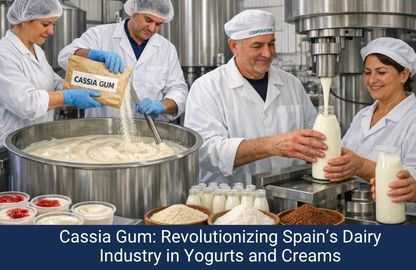
Spain’s dairy sector is anchored by two major production regions: Catalonia in the northeast and Galicia in the northwest. Both are known for its rich dairy traditions-from creamy yogur natural to thick nata (cream)-and both have increasingly embraced Cassia Gum as a stabilizing ingredient in commercial dairy formulations.
In set-style and stirred yogurts, Cassia Powder improves gel firmness and prevents syneresis-the undesirable separation of whey from the curd-during refrigerated storage. Galician dairy cooperatives producing nata for retail use Refined Cassia Gum Powder to achieve consistent viscosity and a smooth pourability that meets consumer expectations. When combined with carrageenan or locust bean gum, Cassia Tora Powder demonstrates strong synergistic thickening, allowing manufacturers to reduce total hydrocolloid use while maintaining texture. This functional efficiency, combined with its status as a natural additive under EU food law, makes attractive to Catalan dairy brands positioning themselves in the clean-label segment.
Cassia Powder’s Role in the Spanish Beverage Industry: From Smoothies to Juices
Barcelona and Valencia have established themselves as Spain’s leading beverage innovation corridors, home to a growing number of cold-pressed juice brands, smoothie manufacturers and functional drink producers. In this segment, ingredient stability is everything-consumers expect no sedimentation, no separation and a consistent pour experience from bottle to glass.
Cassia Gum Powder functions as an effective stabilizer and emulsifier in high-pulp fruit juices and blended smoothies, preventing particle settling without requiring synthetic additives or excessive shaking instructions on labels. Cassia Gum is particularly valued in chilled beverages because it maintains its viscosity-building properties at low temperatures, unlike some competing hydrocolloids. Beverage manufacturers in Barcelona have also begun using Cassia Tora Powder in plant-based protein shakes and oat-based drinks, where it prevents clumping and improves mouthfeel. Its regulatory clearance under EU food standards and compatibility with clean-label positioning continue to drive adoption across Spain’s expanding functional beverage market.
Our Other Product
Guar Gum PowderCassia Gum for Gluten-Free and Vegan Products in Spain’s Food Sector
The demand for gluten-free and plant-based food products has surged across Spain, particularly in urban centers like Barcelona and Madrid, where health-conscious consumer segments are growing rapidly. For manufacturers reformulating traditional products without gluten, eggs or dairy, the challenge lies in replacing the structural and textural functions these ingredients normally provide-and Cassia Gum offers a practical solution.
In gluten-free bread and pasta, Refined Cassia Gum Powder acts as a binder that mimics the elasticity of gluten, improving dough cohesion, reducing crumbliness and extending shelf life. In vegan cheese and plant-based yogurt alternatives, contributes to the firm, sliceable texture that consumers expect from conventional dairy products. Spanish food startups operating in Barcelona’s food-tech ecosystem are increasingly specifying Cassia Tora Powder in their formulation sheets for its dual functionality-binding and moisture retention-which reduces the need for multiple additives. As certification requirements for vegan and gluten-free labeling tighten across EU markets, the clean-label status of E427 Cassia Gum Powder gives formulators a compliant, effective ingredient option.
Cassia Gum Powder in Spanish Meat and Processed Food Products
Spain’s reputation for charcuterie and cured meats is world-renowned, with regions like Salamanca-home to Iberian ham-and the Basque Country-celebrated for its txistorra and morcilla-representing the highest traditions of Spanish meat craft. As these products scale for mass-market distribution, manufacturers face formulation challenges around texture consistency, moisture retention and binding in processed variants.
Cassia Powder is used in emulsified sausage products, meat pâtés and ready-to-eat processed meals to improve water-holding capacity, reduce cooking loss and enhance sliceability. In the Basque Country’s growing ready-meal sector, Refined Cassia Gum Powder is incorporated into sauce-coated meat products to maintain sauce adherence and prevent liquid separation during reheating. Salamanca-based processors producing canned or vacuum-packed meat preparations use Cassia Tora Powder as part of multi-hydrocolloid blends to achieve stable gels that hold under varied temperature conditions. Its approval as Cassia Gum Powder E427 under EU Regulation ensures straightforward regulatory compliance across all Spanish and European market channels.
Conclusion
Spain’s food and beverage industry is undergoing a steady shift toward cleaner, more functional ingredients and Cassia Gum sits at the center of that transition. From stabilizing Gazpacho in Seville to binding gluten-free doughs in Barcelona, from firming yogurts in Galician dairy cooperatives to improving texture in Basque Country processed meats, Cassia Gum Powder proves its versatility across remarkably diverse applications. The ingredient’s regulatory standing as E427 Cassia Gum Powder under EU food law, combined with its plant-based origin and compatibility with clean-label positioning, gives Spanish manufacturers a compliant and commercially viable alternative to synthetic additives. As demand for vegan, gluten-free and minimally processed products continues to grow in urban markets like Madrid and Barcelona, Refined Cassia Gum Powder and Cassia Tora Powder are well-positioned to deepen their footprint across every tier of Spain’s food sector – from artisan confectionery in Valencia to large-scale beverage manufacturing along the Mediterranean coast.
Our Other Product
Fast Hydration Guar Gum PowderFAQs on Cassia Gum in Spain
What is Cassia Gum and why is it used in Spanish food products?
Cassia Gum is a natural hydrocolloid derived from Cassia tora seeds, used as a thickener, stabilizer and binder in a wide range of Spanish food and beverage applications.
Is Cassia Gum Powder E427 approved for use in European food products?
Yes, E427 Cassia Gum Powder is approved under EU Regulation and is legally permitted in specific food categories across all EU member states, including Spain.
How does Refined Cassia Gum Powder differ from standard Cassia Gum?
Refined Cassia Gum Powder undergoes additional processing to reduce impurities and achieve a more consistent particle size, making it suitable for high-purity food-grade applications.
Can Cassia Tora Powder be used in vegan and gluten-free certified products?
Yes, Cassia Tora Powder is plant-derived, free from animal ingredients and gluten-free, making it compatible with both vegan and gluten-free product certifications.
Which food segments in Spain show the highest growth in Cassia Gum adoption?
The fastest-growing segments include gluten-free bakery, plant-based dairy alternatives, functional beverages and ready-to-eat processed meat products, particularly in Barcelona and Madrid.

CEO, Altrafine Gums
With over Four decades of expertise in the natural gums and hydrocolloids industry, Ajit Patel leads Altrafine Gums, a globally recognized manufacturer and exporter of Guar Gum Powder, Cassia Tora Powder (Cassia Gum Powder) and other Hydrocolloids. Under his visionary leadership, the company has built a strong reputation for quality, innovation, and reliability across the food, feed, pet feed, pharmaceutical, mining, oil drilling and cosmetic sectors.
Altrafine Gums has been serving global industries for decades with a focus on sustainable sourcing, research-driven production, and stringent quality control. Its wide product portfolio includes Guar Gum Powder, Cassia Tora Powder (Cassia Gum Powder) and other plant-based hydrocolloids that serve as key functional ingredients in diverse applications.
Ajit Patel’s commitment to excellence ensures that every product from Altrafine meets international standards of performance and purity. He is passionate about advancing the global reach of Indian hydrocolloids, fostering customer trust, and promoting eco-friendly, science-backed solutions that enhance product formulation and performance worldwide.