AI SUMMARY
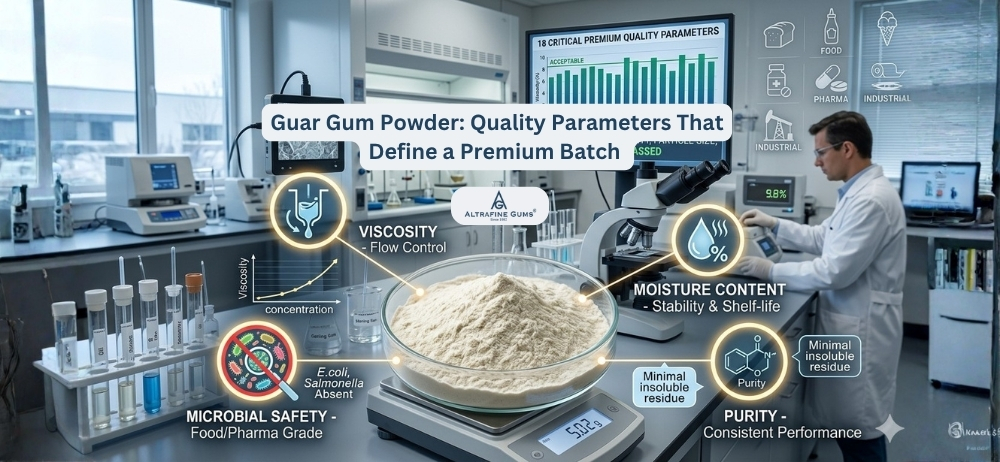
Guar gum powder quality is governed by 18 critical parameters – from viscosity and moisture content to microbial safety and shelf life. This comprehensive guide helps buyers, formulators and procurement teams understand what separates a premium batch from a substandard one. Whether you’re sourcing from a guar gum powder manufacturer, comparing guar gum price points or evaluating a guar gum exporter, these parameters are the definitive checklist for quality assurance across food, pharmaceutical and industrial applications.
Guar Gum Powder: Quality Parameters That Define a Premium Batch
In the world of hydrocolloids, few ingredients command as much commercial importance as guar gum. Derived from the endosperm of the guar bean, guar gum powder has become indispensable across food processing, oil drilling, pharmaceuticals, textiles and paper manufacturing. As global demand intensifies, the role of the guar gum powder manufacturer, guar gum exporter and guar gum suppliers in delivering consistent, high-quality product has never been more critical.
But what exactly separates a premium batch from a mediocre one? The answer lies in 18 measurable, verifiable quality parameters. Whether you are a procurement manager, food technologist or industrial buyer comparing guar gum price across suppliers, this guide delivers the technical foundation you need.
1. Viscosity – The Master Parameter
Viscosity is the single most important quality indicator for guar gum. It measures a solution’s resistance to flow when guar gum is hydrated, typically expressed in centipoise (cP) at a 1% concentration. High-viscosity grades – ranging from 5,000 to 7,000 cP or beyond – are preferred for applications demanding a powerful guar gum thickening agent, such as oil well fracturing fluids and food sauces. Lower viscosity grades suit applications requiring lighter body, such as certain beverages or cosmetic emulsions. A reliable guar gum powder exporter will always declare viscosity values with the testing method and concentration used.
2. Moisture Content – Protecting Shelf Life
Moisture content, ideally maintained below 12%, is directly tied to shelf life stability. Excess moisture accelerates microbial growth, causes powder caking and degrades the polymer chains responsible for viscosity. Guar gum suppliers operating under ISO or food-grade certifications conduct routine moisture analysis using oven-drying or Karl Fischer titration methods. Buyers sourcing guar gum for long-haul export should prioritize manufacturers who pack in moisture-resistant multi-layer bags with desiccants.
3. Purity – What’s Really in Your Powder
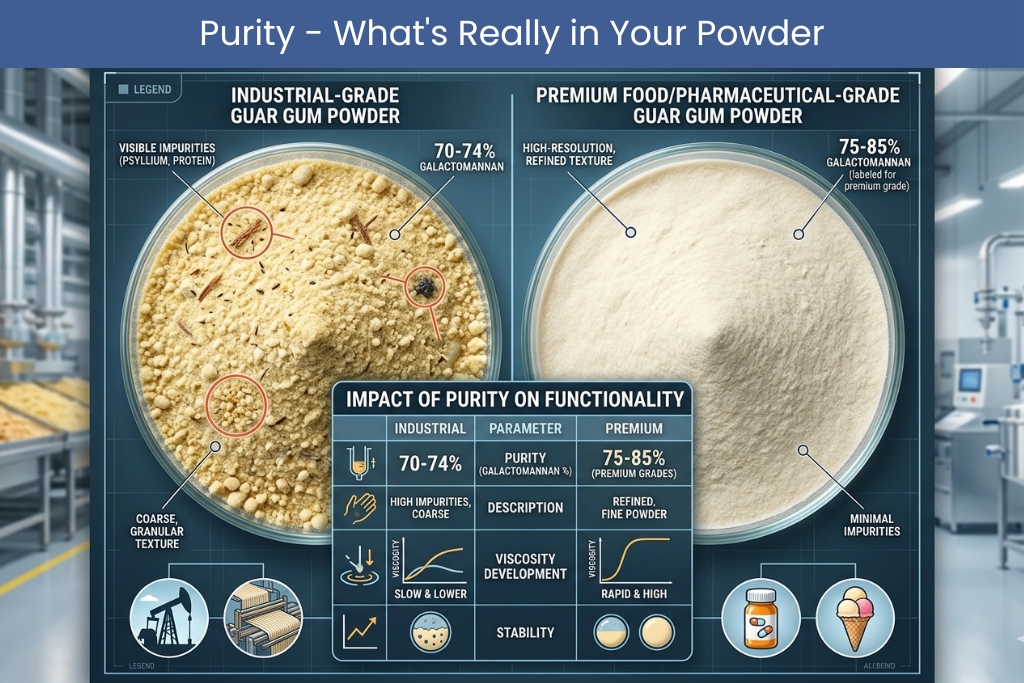
Purity in guar gum powder refers to the galactomannan content, the key polysaccharide responsible for its functionality. Premium guar gum typically contains 75-85% galactomannan, ensuring optimal performance in food and pharmaceutical applications. Lower purity levels are acceptable for industrial-grade guar gum used in sectors like mining or paper manufacturing. Buyers should prioritize purity data when evaluating suppliers, especially for food-grade and pharmaceutical-grade products, to ensure quality and consistency.
4. Particle Size Distribution – Consistency in Every Batch
Particle size distribution (PSD) determines how uniformly the powder disperses and hydrates in solution. Finely milled powder (100–200 mesh) hydrates faster, while coarser grades dissolve more slowly, reducing lump formation during high-shear mixing. Food and pharmaceutical applications requiring smooth textures demand tight PSD specifications. A skilled guar gum powder manufacturer uses laser diffraction or sieve analysis to confirm PSD compliance before dispatch. Inconsistent particle size is one of the leading causes of batch-to-batch performance variation.
5. Ash Content – Measuring Mineral Residue
Ash content measures the inorganic mineral residue remaining after combustion – an indicator of processing cleanliness and purity. High ash content signals excessive soil, mineral contamination or inadequate processing. Food-grade specifications typically require ash content below 1.5%, while some pharmaceutical applications demand even lower thresholds. When comparing guar gum suppliers, ash content data is a silent but revealing quality marker.
6. Color and Appearance – Visual Quality Assurance
Premium guar gum powder presents as a free-flowing, off-white to cream-colored powder with a uniform appearance. Discoloration – yellowing, grayish tones or visible specks – indicates oxidation, heat damage during processing or microbial activity. While color alone does not determine functionality, it directly reflects processing hygiene and raw material quality. Color meters (CIE Lab values) provide objective color measurement used by leading guar gum exporters in quality certificates.
7. Protein Content – A Functional but Double-Edged Parameter
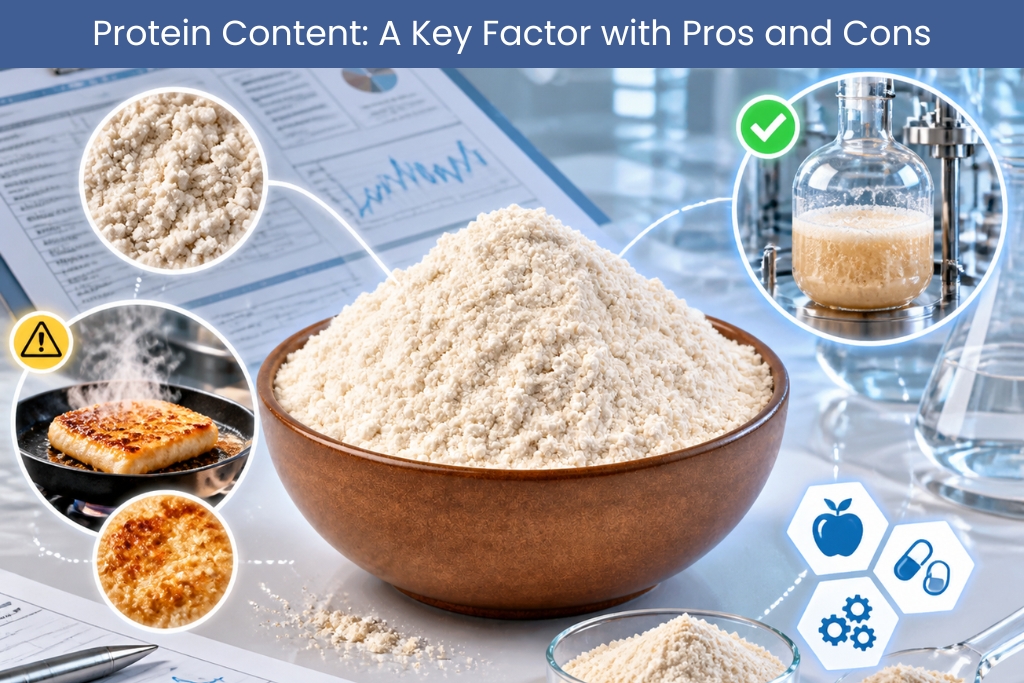
Guar gum naturally contains 4–6% protein. In food applications, residual protein may contribute to allergen concerns or undesirable Maillard browning during heat processing. In fermentation media, protein content can be beneficial. Industrial grade guar gum used in oil drilling or paper manufacturing is less sensitive to protein levels. Guar gum powder manufacturers serving food and pharma clients typically include protein content in their technical data sheets.
Our Other Product
Fast Hydration Guar Gum Powder8. pH Level – Ensuring Formulation Compatibility
The pH of a 1% guar gum solution typically ranges from 5.5 to 7.0. Extreme pH deviations signal contamination, degradation or processing anomalies. As a guar gum stabilizer in dairy products, dressings or pharmaceutical suspensions, pH compatibility with the final formulation is non-negotiable. Most guar gum suppliers report pH on batch certificates and buyers should request this data proactively.
9. Solubility – From Powder to Function
Solubility determines how completely and efficiently the powder disperses in water at ambient or elevated temperatures. Cold-water-soluble grades are essential in ready-to-use food applications, while hot-water-soluble grades suit industrial processes. Poor solubility – resulting in insoluble residues or lumps – compromises end-product texture and process efficiency. Guar gum’s solubility is tested via filtration residue or turbidity measurements and is a key specification requested by food and beverage manufacturers.
10. Gel Strength – Texture Defining Performance
Gel strength describes guar gum’s ability to form a cohesive, elastic network in solution. While guar gum is not a true gelling agent (unlike xanthan or carrageenan), its gel-like viscosity under certain conditions is critical for oil field fracturing, bakery products and pharmaceutical tablet coatings. Gel strength is measured by texture analyzers and rheometers. High gel strength grades from certified guar gum powder exporters command premium pricing in specialized markets.
11. Microbial Contamination – Non-Negotiable Safety
Food-grade and pharmaceutical-grade guar gum must meet strict microbiological standards, including limits on Total Plate Count (TPC), Yeast & Mold, Coliforms, Salmonella and E. coli. Microbial contamination originates from raw bean handling, drying or unhygienic processing environments. Buyers must demand certificates of analysis (CoA) with microbial test results from every lot. A reputable guar gum powder manufacturer conducts in-process and finished-product microbiological testing aligned with Food Chemical Codex (FCC) or BP/USP pharmacopeia standards.
12. Bulk Density – Handling and Storage Efficiency
Bulk density (typically 500–800 g/L for guar gum powder) affects packaging volumes, conveying efficiency and storage space requirements. Lower bulk density grades are fluffier and more prone to dusting, while denser grades pack more compactly. Buyers procuring large volumes from guar gum suppliers should factor bulk density into freight and warehousing cost calculations.
13. Water Holding Capacity – Moisture Management
Water holding capacity (WHC) measures how much water a given mass of guar gum can absorb and retain. High WHC is desirable in bakery, meat processing and gluten-free food applications where moisture retention improves texture and extends freshness. Industrial grade guar gum powder used in construction or paper benefits from controlled WHC as well. This parameter is measured gravimetrically and is increasingly requested by food technology teams.
 Email Us Now!
14. Viscosity Stability – Performance over Time
Viscosity stability measures how well a guar gum solution maintains its original viscosity over time, under varying temperature, pH and shear conditions. Unstable viscosity – common in lower-quality or degraded batches – leads to inconsistent end-product texture and process failures. A guar gum stabilizer used in salad dressings or ice creams must maintain viscosity through multiple freeze-thaw cycles. Leading guar gum exporters provide aging study data to demonstrate long-term viscosity stability.
15. Temperature Sensitivity – Performance under Heat
Guar gum viscosity decreases significantly at elevated temperatures and recovers partially upon cooling. Applications involving hot processing – soups, sauces, retorted foods – require grades with superior temperature stability. Formulators should test viscosity profiles across the intended processing temperature range. Guar gum powder manufacturers catering to food processors often provide temperature-viscosity curve data in its technical documentation.
16. Residual Solvents – A Purity Concern
During processing and chemical modification, solvents including isopropanol or acetone may be introduced. Residual solvent levels must comply with ICH Q3C guidelines for pharmaceutical applications regulations for products. Guar gum suppliers should provide solvent residue testing data upon request, particularly for pharmaceutical-grade batches.
Our Other Product
Cassia Tora Powder17. Particle Shape – Processing Efficiency
Beyond particle size, particle shape – whether angular, rounded or irregular – influences flow behavior, blending uniformity and hydration kinetics. Spherical or near-spherical particles exhibit superior flowability and consistent packing density. Advanced guar gum powder manufacturers use scanning electron microscopy (SEM) for particle morphology analysis in R&D and quality development programs.
18. Shelf Life and Storage Best Practices
Under optimal conditions – cool (below 25°C), dry (relative humidity below 65%) and away from direct sunlight – high-quality guar gum powder retains functional properties for 24 months or beyond. Storage in opened bags requires immediate resealing to prevent moisture ingress. Guar gum suppliers serving markets in tropical or high-humidity regions should recommend climate-controlled warehousing. Batch dating and FIFO (First In, First Out) inventory management are essential practices for maintaining quality integrity.
Conclusion
The 18 parameters outlined above form the complete quality blueprint for evaluating guar gum powder – from sourcing decisions to formulation development. Whether you are assessing guar gum price competitiveness, qualifying a new guar gum exporter or benchmarking your existing guar gum suppliers, these parameters deliver measurable, objective standards.
In a market where quality variance is significant, buyers and formulators who understand viscosity, purity, microbial safety and stability data are better positioned to make procurement decisions that optimize both cost and performance. Partnering with an experienced guar gum powder manufacturer who provides comprehensive, certificate-backed quality data is not just best practice – it is a competitive advantage.
FAQs
What viscosity grade of guar gum should I choose for food applications?
For most food applications, a viscosity of 3,500–5,500 cP (1% solution) is suitable; higher grades are recommended for thickening-intensive uses like sauces and dressings.
How does moisture content affect guar gum powder quality during shipping?
Moisture above 12% promotes microbial growth and caking; buyers should ensure multi-layer moisture-resistant packaging and request moisture content on the certificate of analysis.
What is the difference between food-grade and industrial grade guar gum?
Food-grade guar gum meets strict microbiological and purity standards (FCC/BP); industrial grade guar gum tolerates wider purity ranges suitable for paper, oil field and construction applications.
How do I evaluate a guar gum exporter's reliability beyond price?
Request certificates of analysis covering all 18 quality parameters, check third-party audit certifications and ask for viscosity stability and aging study data from the supplier.
Can guar gum powder be stored for more than two years?
Yes, under optimal conditions (below 25°C, below 65% RH, sealed packaging), premium guar gum powder retains full functional properties for 24–30 months from manufacturing date.

CEO, Altrafine Gums
With over Four decades of expertise in the natural gums and hydrocolloids industry, Ajit Patel leads Altrafine Gums, a globally recognized manufacturer and exporter of Guar Gum Powder, Cassia Tora Powder (Cassia Gum Powder) and other Hydrocolloids. Under his visionary leadership, the company has built a strong reputation for quality, innovation, and reliability across the food, feed, pet feed, pharmaceutical, mining, oil drilling and cosmetic sectors.
Altrafine Gums has been serving global industries for decades with a focus on sustainable sourcing, research-driven production, and stringent quality control. Its wide product portfolio includes Guar Gum Powder, Cassia Tora Powder (Cassia Gum Powder) and other plant-based hydrocolloids that serve as key functional ingredients in diverse applications.
Ajit Patel’s commitment to excellence ensures that every product from Altrafine meets international standards of performance and purity. He is passionate about advancing the global reach of Indian hydrocolloids, fostering customer trust, and promoting eco-friendly, science-backed solutions that enhance product formulation and performance worldwide.