



The Role of Guar Gum in Indonesia’s Textile Industry
Table of Contents
AI Summary: The Role of Guar Gum in Indonesia’s Textile Industry
Guar gum have become essential across Indonesia’s major textile cities, serving functions from yarn sizing and dye thickening to sustainable wet processing. Jakarta and Surabaya rely on it for fabric strength and colour uniformity, while Bandung leads in digital print paste innovation using guar-based formulations. Semarang’s mills are replacing synthetic thickeners with guar powder to meet compliance standards and Yogyakarta’s batik producers use it to maintain precision in traditional and modern dyeing alike. Medan is emerging as a high-potential market, leveraging port access to source roasted guar korma competitively and expand into technical textile applications. Across the country, guar gum’s natural origin, functional versatility and biodegradable profile make it a cornerstone ingredient in Indonesia’s push toward quality-driven and environmentally responsible textile manufacturing.
Guar Gum’s Contribution to Textile Manufacturing in Jakarta
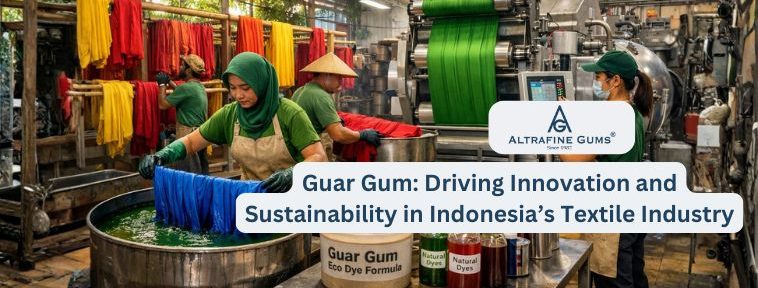
Jakarta, as Indonesia’s commercial capital, houses one of the country’s most dynamic textile manufacturing sectors. Across its industrial zones, guar gum has become a foundational ingredient in dyeing and finishing operations. Derived from the guar plant’s endosperm, this natural polysaccharide functions as a sizing agent that coats yarn fibres, reducing breakage during weaving. In reactive dyeing – a process widely used in Jakarta’s mills for cotton and blended fabrics – guar gum powder acts as a thickener that controls dye migration, ensuring sharp colour definition and uniform penetration. The result is a finished fabric with vibrant, consistent hues and a smoother hand feel, both of which meet the high standards demanded by Jakarta’s export-oriented manufacturers.
 Click Here!
Impact of Guar Gum Powder in the Textile Production of Surabaya
Surabaya’s textile factories, concentrated in the Rungkut Industrial Estate, produce large volumes of woven and knitted fabrics for both domestic and international markets. The adoption of guar gum powder in these facilities has directly improved fabric tensile strength and surface texture. When applied as a warp sizing agent, it binds fibres together, reducing yarn hairiness and minimising loom downtime caused by thread breakage. Beyond structural improvement, guar gum enhances the stiffness and body of finished cloth, giving it the firmness buyers expect in formal and workwear segments. Its biodegradable profile also reduces wastewater treatment loads, a practical advantage for Surabaya’s factories operating under tightening environmental compliance requirements.
Guar Gum in Textile Applications: A Key Ingredient in Bandung’s Textile Innovations
Bandung has long been Indonesia’s creative textile hub, home to batik workshops, fashion labels and technical fabric producers. Here, the use of guar gum in textile applications has evolved beyond conventional sizing into innovative formulations. Designers and technologists in Bandung are experimenting with guar gum blends that impart specific surface effects – from a matte finish on premium cotton to controlled sheen on synthetic blends. Small-batch artisan producers value its compatibility with natural dyes, which supports Bandung’s growing eco-fashion movement. Meanwhile, larger mills use it in digital textile printing as a print paste thickener, achieving fine-detail patterns with minimal colour bleed – a quality requirement that has elevated Bandung’s reputation in high-end fabric exports.
The Role of Guar Powder: Sustainable Textile Practices in Semarang
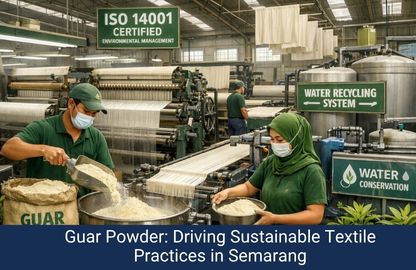
Semarang’s textile sector has increasingly aligned itself with sustainability targets, driven by international buyer demands and Indonesia’s national green industry agenda. Guar powder plays a central role in this shift. Unlike synthetic thickeners derived from petrochemicals, guar powder is plant-based, fully biodegradable and desizes cleanly from fabric with minimal water usage – a significant advantage given the water-intensive nature of textile wet processing. Several Semarang factories have replaced carboxymethyl cellulose (CMC) and polyvinyl alcohol (PVA) with guar powder in warp sizing applications, reducing their chemical oxygen demand (COD) in effluent by a measurable margin. This transition supports ISO 14001 certification goals and appeals to European buyers who conduct environmental audits before placing orders.
Guar Gum Powder as a Natural Additive in Yogyakarta’s Textile Dyeing Process
Yogyakarta occupies a singular position in Indonesian textiles – a city where centuries-old batik traditions coexist with contemporary fabric production. For batik makers, the resist-dyeing process demands precise control over dye flow and guar gum powder delivers exactly that. Applied as a paste to define dye boundaries, it prevents feathering in intricate motifs, preserving the sharpness of traditional Javanese patterns. Modern commercial dyehouses in Yogyakarta have adopted it in vat and reactive dye systems for its ability to deliver level dyeing on cellulosic fibres. Roasted guar korma, a derivative obtained by roasting split guar seeds, is also gaining attention in Yogyakarta’s smaller processing units as a cost-effective raw material for producing customised gum grades suited to specific viscosity requirements in thickened dye pastes.
The Future of Guar Gum in Indonesia’s Textile Industry: Potential in Medan
Medan, North Sumatra’s industrial capital, is an emerging player in Indonesia’s textile landscape. With its proximity to plantation-based raw materials and a growing manufacturing base, Medan is well-positioned to increase guar gum adoption. Current use is concentrated in yarn sizing for locally woven sarongs and cotton fabrics, but expansion into digital printing pastes and technical textiles is expected as the city’s industrial capacity grows. Supply chain advantages also work in Medan’s favour – direct sourcing of roasted guar korma from international traders via Belawan Port reduces input costs compared to factories in Java. As Indonesian textile manufacturers face pressure to lower carbon footprints while maintaining quality, guar gum’s natural origin, functional versatility and competitive pricing make it an ingredient with considerable long-term relevance across all of the country’s major textile centres.
 Email Us Today!
Conclusion
Guar gum has firmly established itself as a multifunctional and indispensable ingredient across Indonesia’s textile industry, bridging the gap between performance demands and sustainability goals. From Jakarta’s export-driven mills to Yogyakarta’s artisan batik workshops, its applications in sizing, dyeing and finishing consistently deliver measurable improvements in fabric quality and production efficiency. The growing shift from synthetic thickeners to guar gum powder reflects a broader industry commitment to reducing environmental impact without compromising output standards. With Medan poised for expansion and cities like Bandung and Semarang already pushing boundaries in innovation and green practices, the trajectory for guar gum adoption across Indonesia is clearly upward. As global buyers increasingly mandate eco-conscious sourcing, roasted guar korma and its refined derivatives offer Indonesian manufacturers a natural, cost-effective and future-ready solution to remain competitive on the world stage.
FAQs on Guar Gum Powder
What is the primary function of guar gum in textile manufacturing?
Guar gum functions mainly as a sizing and thickening agent, improving yarn strength during weaving and ensuring uniform dye distribution in printing and dyeing processes.
How does guar gum powder differ from synthetic thickeners used in the textile industry?
Guar gum powder is plant-derived and biodegradable, making it environmentally preferable to petrochemical-based synthetic thickeners, which generate higher chemical loads in textile effluent.
What is roasted guar korma and how is it used in textiles?
Roasted guar korma is a processed guar seed derivative used as a raw material to produce customised gum grades with specific viscosity profiles for dye paste and sizing applications.
Why is guar powder preferred for sustainable textile practices?
Guar powder reduces COD in wastewater, desizes easily with less water and is biodegradable - all of which help textile factories meet environmental compliance and green certification standards.
Which Indonesian cities show the most potential for expanded guar gum adoption?
Medan shows strong growth potential due to its port access for guar imports and expanding textile base, while Bandung and Yogyakarta lead in innovative, artisan and eco-focused guar gum applications.
CEO, Altrafine Gums
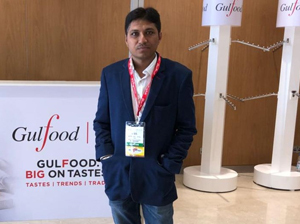
With over Four decades of expertise in the natural gums and hydrocolloids industry, Ajit Patel leads Altrafine Gums, a globally recognized manufacturer and exporter of Guar Gum Powder, Cassia Tora Powder (Cassia Gum Powder) and other Hydrocolloids. Under his visionary leadership, the company has built a strong reputation for quality, innovation, and reliability across the food, feed, pet feed, pharmaceutical, mining, oil drilling and cosmetic sectors.
Altrafine Gums has been serving global industries for decades with a focus on sustainable sourcing, research-driven production, and stringent quality control. Its wide product portfolio includes Guar Gum Powder, Cassia Tora Powder (Cassia Gum Powder) and other plant-based hydrocolloids that serve as key functional ingredients in diverse applications.
Ajit Patel’s commitment to excellence ensures that every product from Altrafine meets international standards of performance and purity. He is passionate about advancing the global reach of Indian hydrocolloids, fostering customer trust, and promoting eco-friendly, science-backed solutions that enhance product formulation and performance worldwide.