



Guar Gum Powder Viscosity Explained: CPS, Mesh Size, and What the Numbers Mean
Table of Contents
AI Summary
This article explains guar gum powder viscosity, how it is measured in CPS (centipoise) using a Brookfield viscometer, and how mesh size relates to viscosity and hydration. It covers why viscosity matters, how to read a specification sheet, the differences between 100, 200 and 300 mesh grades, and the other quality parameters buyers should check. The result is a clear, practical guide for buyers and formulators comparing guar gum powder grades and suppliers.
Why Viscosity Matters in Guar Gum Powder
Viscosity is the single most important performance property of guar gum powder. It measures how much the gum thickens a solution, and it directly determines how the product behaves in food, industrial and oilfield applications. A higher viscosity grade builds more thickness at the same dosage, which affects everything from texture to cost in use.
Because viscosity is so central, buyers very often specify and search for guar gum powder by its CPS value. Terms such as 5000 cps or 5000/5500 cps guar gum are common in purchasing, so understanding what these numbers mean, and how they are measured, is essential for selecting the right grade and comparing suppliers fairly.
 Call Us Now!
What CPS (Centipoise) Means
CPS, or centipoise, is the unit used to measure viscosity. In simple terms, the higher the CPS value, the thicker the solution the gum produces. Water has a viscosity of about 1 centipoise, while a hydrated guar gum powder solution can reach several thousand centipoise, which is why guar is such an efficient thickener.
A guar specification usually gives both a minimum and a maximum CPS, defining the range within which the product will perform. Buyers rely on this range to predict how the gum will behave in their process, and a consistent, well-controlled CPS is a key marker of a quality guar gum powder.
How Guar Gum Viscosity Is Measured
Viscosity figures only mean something when the test conditions are stated, because the same gum can read differently under different methods. Guar gum powder viscosity is typically measured using a Brookfield viscometer under defined conditions: a temperature of 25°C, a rotation speed of 20 rpm, spindle number 4, and a 1% solution.
These conditions matter because temperature, spindle, speed and solution concentration all affect the reading. When comparing products from different suppliers, buyers should confirm that the CPS values were measured under the same method; otherwise the comparison is not valid. A reputable supplier always states the full test conditions alongside the CPS value.
Read Our Article
The Use of Guar Gum in Ceramic and Tile ManufacturingThe Relationship Between Mesh Size and Viscosity
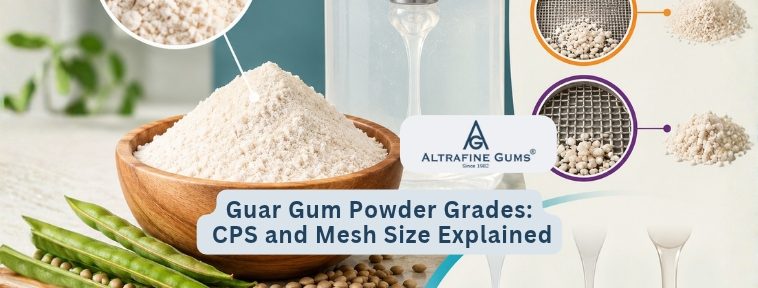
Mesh size describes how fine the guar gum powder is ground, based on the sieve through which it passes. Common grades are 100 mesh, 200 mesh and 300 mesh, with a higher number indicating a finer powder. Mesh size influences how quickly the gum hydrates and how its viscosity develops. Finer grades have more surface area and generally hydrate faster, reaching their viscosity more quickly in solution. The specific viscosity ranges, however, are set by grade, so buyers should always read the specification sheet rather than assume. The table below shows how viscosity and other parameters are defined across 100, 200 and 300 mesh grades.
Guar Gum Powder Specifications at a Glance
The following specification table summarizes the key parameters for guar gum powder across 100, 200 and 300 mesh grades, including viscosity, moisture, protein, ash, pH, galactomannan assay and heavy metals.
| Specification | 100 Mesh | 200 Mesh | 300 Mesh |
| Viscosity – Brookfield Viscometer, 25°C, 20 rpm, Spindle No. 4, 1% Solution (Min.) | 2500 / 3500 Cps | 2500 / 3500 Cps | 2500 / 3500 Cps |
| Viscosity (Max.) | 4500 / 5000 Cps | 8000 / 9000 Cps | 4500 / 5000 Cps |
| Moisture | 12 % Max. | 12 % Max. | 12 % Max. |
| Passing | 98 – 99 % Min. | 90 – 99 % Min. | 98 – 99 % Min. |
| Proteins (N x 6.25) | 5.0 % Max. | 5.0 % Max. | 5.0 % Max. |
| Acid-insoluble matter | 3.0 % Max. | 3.0 % Max. | 3.0 % Max. |
| Ash | 1.0 % Max. | 1.0 % Max. | 1.0 % Max. |
| pH | 5.5 – 7.0 | 5.5 – 7.0 | 5.5 – 7.0 |
| Assay (Galactomannan content) | 80 % Min. | 80 % Min. | 80 % Min. |
| Arsenic | 0.1 ppm Max. | 0.1 ppm Max. | 0.1 ppm Max. |
| Lead | 0.2 ppm Max. | 0.2 ppm Max. | 0.2 ppm Max. |
| Mercury | 0.1 ppm Max. | 0.1 ppm Max. | 0.1 ppm Max. |
| Cadmium | 0.1 ppm Max. | 0.1 ppm Max. | 0.1 ppm Max. |
| Heavy Metals | 5 ppm Max. | 5 ppm Max. | 5 ppm Max. |
This kind of specification sheet is what buyers use to compare grades and verify quality. Each parameter tells part of the story, and together they define a premium, consistent guar gum powder.
Our Other Product
Cassia Tora PowderOther Key Quality Parameters
Beyond viscosity, several other parameters define guar gum powder quality. Moisture (typically 12% max) affects shelf life and flow, while protein content (around 5% max, measured as N x 6.25) and acid-insoluble matter (around 3% max) indicate purity. Ash content (around 1% max) reflects mineral residue.
The galactomannan assay, usually 80% minimum, is especially important, because galactomannan is the component responsible for guar’s thickening power; a higher assay indicates a purer, more functional product. pH (typically 5.5 to 7.0) and strict limits on heavy metals such as arsenic, lead, mercury and cadmium confirm the product is safe and suitable for food and other sensitive applications.
Choosing the Right Viscosity Grade
Selecting the correct guar gum powder grade means matching viscosity and mesh to the needs of the application. Food applications such as sauces, dairy and bakery often use specific viscosity grades to achieve the right texture, while industrial and oilfield uses may call for different viscosity and hydration behavior.
The right choice balances performance and cost, since higher viscosity grades thicken more efficiently and can be used at lower dosages. Understanding both the CPS value and the mesh size allows buyers to specify exactly what they need rather than relying on general descriptions.
Why Consistent Viscosity Matters for Buyers
For manufacturers, consistency is as important as the headline viscosity number. If viscosity varies from batch to batch, product texture and process behavior become unpredictable, which can lead to quality problems and waste. A tightly controlled CPS range is therefore a mark of a dependable supplier.
Sourcing guar gum powder with certificate backed specifications, tested under clearly stated conditions, gives buyers confidence that each batch will perform as expected. This reliability is ultimately what allows manufacturers to standardize their processes and maintain consistent product quality.
About Altrafine Gums
Altrafine Gums is an Ahmedabad based manufacturer, processor and exporter of natural hydrocolloids and gum powders, including guar gum powder, fast hydration guar gum powder, cassia tora powder, tamarind kernel powder, sesbania gum powder, psyllium husk and locust bean gum powder. With modern processing facilities in Gujarat, India and recognized quality certifications, the company supplies food grade and industrial grade material to manufacturers worldwide.
Altrafine Gums offers guar gum powder in a range of mesh sizes and viscosity grades, with consistent, certificate backed specifications supported by in-house testing. This helps buyers select the right grade for their application and maintain reliable quality across every batch.
 Email Us Now!
Conclusion
Viscosity, measured in CPS, is the defining performance property of guar gum powder, and understanding how it is measured and how it relates to mesh size is essential for buyers and formulators. A CPS value only has meaning alongside its test conditions, which is why the Brookfield method at 25°C, 20 rpm, spindle 4 and a 1% solution is the standard reference point.
Read together with mesh size, moisture, galactomannan assay and the other specification parameters, viscosity allows buyers to select the right grade and compare suppliers accurately. Sourcing consistent, certificate backed guar gum powder from an experienced manufacturer ensures predictable performance in every batch.
FAQs
What does CPS mean in guar gum powder?
CPS, or centipoise, is the unit of viscosity. The higher the CPS value, the thicker the solution the guar gum powder produces. A specification usually gives a minimum and maximum CPS defining the product’s performance range.
How is guar gum viscosity measured?
Guar gum powder viscosity is typically measured on a Brookfield viscometer at 25°C, 20 rpm, with spindle number 4 and a 1% solution. These conditions must be stated for CPS values to be compared fairly between suppliers.
How does mesh size affect viscosity?
Mesh size describes how finely the powder is ground. Finer grades (a higher mesh number) have more surface area and generally hydrate faster. The exact viscosity ranges are set by grade, so the specification sheet should always be checked.
What is a good galactomannan content for guar gum?
Galactomannan is the component responsible for guar’s thickening power. A galactomannan assay of around 80% minimum indicates a pure, highly functional guar gum powder.
Which other parameters define guar gum quality?
Besides viscosity, key parameters include moisture (around 12% max), protein (around 5% max), acid-insoluble matter (around 3% max), ash (around 1% max), pH (5.5 to 7.0) and strict heavy metal limits.
Where can buyers source guar gum powder by specification?
Buyers should work with an experienced guar gum supplier that offers a range of mesh and viscosity grades with certificate backed specifications tested under clearly stated conditions.

CEO, Altrafine Gums
With over Four decades of expertise in the natural gums and hydrocolloids industry, Ajit Patel leads Altrafine Gums, a globally recognized manufacturer and exporter of Guar Gum Powder, Cassia Tora Powder (Cassia Gum Powder) and other Hydrocolloids. Under his visionary leadership, the company has built a strong reputation for quality, innovation, and reliability across the food, feed, pet feed, pharmaceutical, mining, oil drilling and cosmetic sectors.
Altrafine Gums has been serving global industries for decades with a focus on sustainable sourcing, research-driven production, and stringent quality control. Its wide product portfolio includes Guar Gum Powder, Cassia Tora Powder (Cassia Gum Powder) and other plant-based hydrocolloids that serve as key functional ingredients in diverse applications.
Ajit Patel’s commitment to excellence ensures that every product from Altrafine meets international standards of performance and purity. He is passionate about advancing the global reach of Indian hydrocolloids, fostering customer trust, and promoting eco-friendly, science-backed solutions that enhance product formulation and performance worldwide.