





Cassia Gum: Pricing, Supply Chain & Market Dynamics
Table of Contents
AI Summary:
The pricing of Cassia Gum is shaped by a convergence of supply chain vulnerabilities, raw material availability, processing costs, macroeconomic forces and regulatory frameworks. Sourced primarily from Cassia Tora Powder-producing regions in India and Southeast Asia, the cost of cassia gum is sensitive to monsoon patterns, seed yield fluctuations and rising energy input costs. Global demand from food, pet food and industrial sectors continues to exert upward pressure on Cassia Gum Powder Price, while currency volatility and trade tariffs add further complexity to international procurement. Understanding these dynamics is essential for buyers, formulators and traders operating in the cassia gum market.
Cassia Gum: Global Supply and Demand Dynamics
Cassia Gum is a galactomannan-based hydrocolloid derived from the endosperm of Cassia obtusifolia and Cassia tora seeds, primarily cultivated in India, China and parts of Southeast Asia. Its regulatory status as a food additive – approved under the European Union designation E427 Cassia Gum Powder and increasingly accepted in Asian markets – has driven steady global demand, particularly from the pet food and dairy industries.
However, supply chain disruptions have repeatedly exposed the vulnerability of this niche commodity. Logistical bottlenecks following the pandemic, current ongoing container shipping constraints and port congestion in South Asian export hubs have compressed availability and spiked Cassia Gum Powder Price at short notice. When major buyers from Europe or North America place large forward orders simultaneously, spot market shortages become common, amplifying price volatility.
Seasonal variations further complicate supply. Cassia Tora Powder output peaks post-harvest, which temporarily eases supply pressure. Outside this window, inventory drawdowns at processing facilities become the primary buffer – and when those deplete faster than expected, procurement costs rise sharply. Demand-side growth in the pet food industry, where Cassia Gum Powder E427 functions as a gelling and thickening agent, adds persistent baseline pressure that does not ease between harvests.
Raw Material Availability and Its Impact on Pricing
The cost of cassia gum is directly tied to the availability and quality of cassia seeds – the foundational raw material from which refined grades are produced. India accounts for the majority of global cassia seed supply, with Rajasthan, Madhya Pradesh and Andhra Pradesh as primary cultivation zones. Any disruption to agricultural output in these regions has an immediate upstream effect on Refined Cassia Gum Powder pricing.
Rainfall patterns are the single most influential agronomic variable. Deficient monsoons reduce pod formation and seed weight, yielding smaller, lower-endosperm seeds that produce less extractable gum per tonne of raw input. Conversely, excessive rainfall during the flowering stage leads to crop diseases and yield losses. Both extremes translate into tighter seed supplies and elevated raw material costs that cascade through to final Cassia Gum Powder prices.
Competition for cassia seeds between gum processors and other industries – such as animal feed manufacturers who also utilize Cassia Tora Powder as a feed ingredient – adds another layer of raw material pressure. When feed demand is strong, seed prices can be bid up independently of gum market fundamentals, raising the input cost floor for processors of E427 Cassia Gum Powder. Quality differentiation also plays a role: high-endosperm, premium-grade seeds command a price premium of 20–35% over standard grades, directly influencing the cost structure of Refined Cassia Gum Powder.
Cassia Gum Powder: Manufacturing and Processing Costs
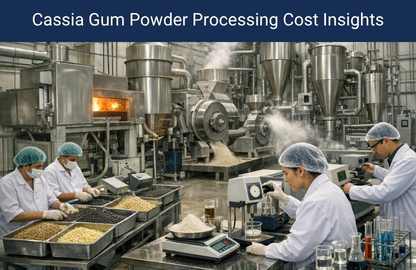
Processing cassia seeds into commercially viable Cassia Gum Powder involves multiple cost-intensive stages: dehusking, splitting, endosperm separation, milling, refining and quality standardization. Each stage contributes to the final Cassia Gum Powder Price and cost pressures at any point affect overall margins and buyer-facing pricing.
Energy costs are a critical variable in this process. The drying, grinding and purification stages are energy-intensive, making processors sensitive to fluctuations in electricity tariffs and diesel prices. In recent years, rising global energy prices have meaningfully increased the per-tonne production cost of Refined Cassia Gum Powder, particularly for facilities running high-throughput operations. Labor costs in producing countries, though historically lower than in Western markets, have also risen with inflation, adding incremental pressure.
The production of food-grade Cassia Gum Powder requires adherence to strict specification standards – including low heavy metal content, controlled microbial counts and precise viscosity profiles. Meeting these standards necessitates investment in laboratory infrastructure, third-party testing and sometimes re-processing of off-spec batches. These quality compliance costs are non-trivial and are embedded in the price differential between food-grade and technical-grade Cassia Powder. Additionally, packaging in moisture-barrier materials and cold-chain logistics for export-grade products add a further cost layer that smaller buyers often underestimate.
Our Other Product
Guar Gum PowderCassia Powder: Economic Factors and Exchange Rates
Because Cassia Gum is predominantly produced in India and traded globally in US dollars, exchange rate dynamics exert a significant influence on international Cassia Gum Powder Price. When the Indian Rupee depreciates against the USD, Indian exporters temporarily gain a pricing advantage – enabling competitive offers to European and American buyers. Conversely, Rupee appreciation compresses export margins and can reduce the attractiveness of Indian-origin Cassia Powder in dollar-denominated contracts.
Inflationary pressures in key producing countries affect domestic input costs – seeds, labor, energy and packaging – which are priced in local currency. When domestic inflation runs ahead of exchange rate adjustments, the real cost of cassia gum production rises even without any change in the USD spot price. Buyers on long-term fixed-price contracts can find their suppliers requesting renegotiation as input cost inflation erodes processing margins.
Global commodity inflation cycles also affect Cassia Gum indirectly. As competing hydrocolloids – such as guar gum, locust bean gum and tara gum – become more expensive due to their own supply-demand shifts, buyers substitute toward Cassia Gum Powder E427, increasing demand and supporting price increases. This cross-commodity substitution effect means that the cost of cassia gum cannot be analyzed in isolation; it must be contextualized within the broader hydrocolloid and food-ingredient pricing environment.
 Call Now!
Read Our Article
Cassia Gum Powder MarketCassia Gum Pricing: Impact of Government Regulations and Tariffs
Regulatory approval is a foundational prerequisite for Cassia Gum Powder to access key markets – and the status of those approvals directly affects both demand and price. The European Union’s approval of Cassia Gum for use in canned pet food (under strict maximum usage levels) opened a significant market, enabling Indian processors to export at premium prices into a regulated, quality-conscious buyer base.
Import tariffs and trade policies in destination markets directly affect the landed cost of Cassia Gum. European Union tariff schedules, US Harmonized Tariff Schedule classifications and country-specific anti-dumping measures can add to the effective cost of cassia gum, depending on origin and product classification. Trade disputes – have periodically created tariff uncertainty, prompting buyers to seek alternative supply origins or build precautionary inventory, both of which influence short-term price behavior.
On the supply side, Indian government export policies, including periodic adjustments to the Minimum Export Price (MEP) for seed-derived commodities and changes to goods and services tax structures, affect the competitiveness of Indian-origin Cassia Tora Powder and downstream gum products. Regulatory changes mandating enhanced food safety certifications – such as FSSC 22000 or FSSAI compliance for export-grade Cassia Gum Powder – increase compliance costs for processors, which are ultimately passed through to buyers. The regulatory environment thus acts as both a market access gatekeeper and a cost multiplier across the cassia gum supply chain.
Conclusion
The pricing of Cassia Gum is the product of interlocking variables spanning agriculture, manufacturing, macroeconomics and regulatory policy. Buyers seeking cost predictability must track seed harvest conditions in South Asia, monitor exchange rate trends between the Rupee and USD and stay ahead of evolving import tariff schedules in their target markets. Producers of Cassia Tora Powder, in turn, face the dual challenge of managing input cost volatility while meeting increasingly stringent food-grade specifications. As global demand for plant-based hydrocolloids grows and regulatory frameworks tighten, the strategic importance of understanding the full cost of cassia gum – from field to formulation – will only increase for procurement teams and market participants alike.
FAQs
What is the primary use of Cassia Gum Powder in the food industry?
Cassia Gum Powder E427 is primarily used as a gelling and thickening agent in canned pet food, dairy products and meat applications due to its strong synergistic gelation with carrageenan.
Why does Cassia Gum Powder Price fluctuate seasonally?
Seasonal price swings occur because cassia seed harvests are concentrated in a narrow post-monsoon window, creating periodic supply tightness and inventory pressure outside the harvest season.
How does Refined Cassia Gum Powder differ from standard grades?
Refined Cassia Gum Powder undergoes additional purification and micronization to meet food-grade viscosity and safety specifications, commanding a premium over technical-grade Cassia Powder.
What role do exchange rates play in the cost of cassia gum for international buyers?
Since cassia gum is priced in USD but produced in Rupee-denominated economies, Indian Rupee fluctuations against the dollar directly affect export competitiveness and landed cost for importers.
Are tariffs a significant factor in the final Cassia Gum Powder Price?
Yes - import tariffs, anti-dumping duties and country-of-origin classifications can add to the cost of E427 Cassia Gum Powder, making regulatory monitoring essential for procurement planning.

CEO, Altrafine Gums
With over Four decades of expertise in the natural gums and hydrocolloids industry, Ajit Patel leads Altrafine Gums, a globally recognized manufacturer and exporter of Guar Gum Powder, Cassia Tora Powder (Cassia Gum Powder) and other Hydrocolloids. Under his visionary leadership, the company has built a strong reputation for quality, innovation, and reliability across the food, feed, pet feed, pharmaceutical, mining, oil drilling and cosmetic sectors.
Altrafine Gums has been serving global industries for decades with a focus on sustainable sourcing, research-driven production, and stringent quality control. Its wide product portfolio includes Guar Gum Powder, Cassia Tora Powder (Cassia Gum Powder) and other plant-based hydrocolloids that serve as key functional ingredients in diverse applications.
Ajit Patel’s commitment to excellence ensures that every product from Altrafine meets international standards of performance and purity. He is passionate about advancing the global reach of Indian hydrocolloids, fostering customer trust, and promoting eco-friendly, science-backed solutions that enhance product formulation and performance worldwide.