




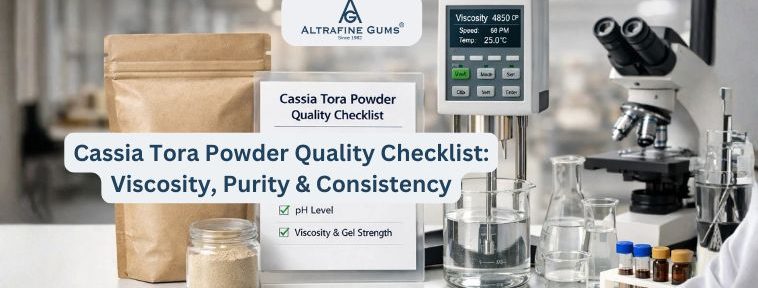
Cassia Tora Powder Quality Checklist for Buyers: Viscosity, Purity and Consistency Checks
Table of Contents
Cassia Tora Powder Quality Checklist Overview for Buyers
When sourcing Cassia Tora Powder, a clear quality checklist is essential to avoid performance issues down the line. This powder, a core thickening agent widely used in industries like food processing, pharmaceuticals and pet food production, can vary significantly in quality based on its source, processing method and storage conditions. That’s why buyers need to implement a structured inspection framework before making procurement decisions.
A consistent Cassia Powder quality ensures it behaves predictably in application, whether it’s used as a gelling agent in food products or as a stabilizer in industrial formulations. The first step in ensuring quality is aligning procurement, quality control and application teams on the same acceptance standards. Everyone should be clear on what needs to be tested, why it’s important and what the minimum benchmarks are.
From viscosity checks to purity and consistency evaluations, a systematic approach to testing can help buyers ensure they’re getting Food Grade Cassia Gum Powder that meets the required standards. It’s also important to monitor critical specifications that influence product behavior, such as mesh size, moisture content and batch uniformity. Inconsistent parameters can cause unpredictable performance, customer complaints or even product recalls.
Read Our Article
Understanding Cassia Tora Powder: Applications and BenefitsCassia Tora Powder Viscosity Checks For Functional Performance
Viscosity is one of the most important functional properties of Cassia Gum Powder. It determines how well the powder will thicken a solution, how stable the resulting gel will be and how it will interact with other components in a formulation. Inconsistent viscosity can lead to dramatic differences in product behavior, which is especially critical for food and pharma applications.
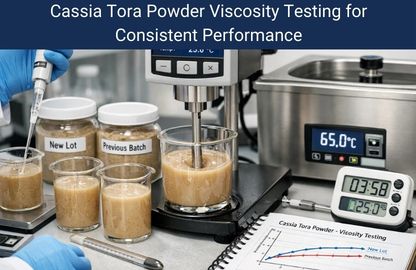
When buyers receive a new lot of Cassia Tora Powder or Refined Cassia Gum Powder, they should begin by testing viscosity at standardized concentrations and temperatures. This ensures a fair comparison with previous batches and helps catch any significant deviation. Viscosity drift over time or between shipments may indicate changes in source quality, processing techniques or even adulteration with other plant materials.
High-quality Cassia Gum Powder E427 will maintain consistent viscosity within a tight range. It should also hydrate well in water, achieving maximum viscosity within a predictable timeframe. Variations here can affect processing times, gelling properties and texture outcomes in the final product.
To test viscosity, use a Brookfield viscometer or similar device, following ASTM or internal standards. Note whether the viscosity stabilizes quickly or continues rising over time – a reliable product should not have erratic behavior. Record and compare results over multiple batches to create a functional performance history.
Cassia Tora Powder Purity Checks For Clean And Safe Composition
Purity is crucial when selecting Cassia Gum or Cassia Tora Powder for applications that require safety and regulatory compliance. Food Grade Cassia Gum Powder, in particular, needs to meet strict limits for contaminants, foreign matter and microbial content. Impurities can alter the powder’s behavior, compromise safety or even invalidate product claims.
Buyers should test for common contaminants such as dust, husk fragments, plant stems or accidental additives. In some cases, Cassia Powder is adulterated with cheaper gums or fillers to reduce costs, but this compromises product integrity. Reputable suppliers will offer detailed COAs (Certificates of Analysis), but independent verification through third-party labs is always a smart step.
Testing protocols may include ash content analysis, heavy metal detection and pesticide residue evaluation. A lower total ash percentage indicates fewer inorganic impurities, while microbiological testing ensures the powder doesn’t carry pathogens that could cause spoilage or health risks. For E427 Cassia Gum Powder used in food, buyers must ensure the product complies with international food safety standards, including JECFA and EFSA specifications. If the powder is intended for export, even stricter scrutiny is necessary to avoid shipment rejection or compliance issues in target markets.
Our Other Product:
Guar Gum PowderCassia Tora Powder Consistency Checks For Batch-To-Batch Reliability
Consistency across batches is a non-negotiable for manufacturers using Cassia Gum Powder in continuous production systems. Whether you’re producing pet food, sauces or pharmaceutical gels, each batch must behave identically to ensure repeatability and customer satisfaction. Cassia Powder that performs well in one batch but fails to hydrate properly in the next can wreak havoc on production timelines.
This is why consistency testing is a top priority. Begin by comparing key metrics like viscosity, hydration time and particle size between previous and current batches. Even small changes in these parameters can cascade into bigger issues, such as poor gelling, phase separation or altered texture.
A good practice is to retain a reference sample from previous purchases and run parallel tests with new shipments. Use the same lab setup and conditions to reduce testing bias. Tracking batch performance helps detect subtle shifts in quality that aren’t obvious from visual inspection alone.
In addition, some suppliers may use slightly different processing technologies that affect molecular weight or solubility. If your application relies on precise gel formation, these differences become critical. Reliable vendors will maintain strict batch control and provide batch-specific documentation for verification.
Cassia Tora Powder Moisture And Storage Stability Checks
Moisture content in Cassia Gum Powder directly affects its flow, shelf life and usability. High moisture can lead to caking, microbial growth or degradation during storage and transit. On the other hand, overly dry powder may lead to dusting, handling challenges and inconsistent hydration.
Ideally, the moisture content of Cassia Tora Powder should be below 12% for optimal storage. Use a standard moisture analyzer to verify this at the point of receipt. If you’re dealing with Refined Cassia Gum Powder for long-term storage or export, proper packaging is essential. Moisture-proof, double-layered bags with inner linings offer protection against humidity and contamination.
It’s also worth conducting accelerated aging tests to check how the powder performs under various temperature and humidity conditions. This is especially useful for buyers sourcing large volumes for seasonal or staggered production runs. Storage stability ensures the Cassia Powder will maintain its viscosity and hydration properties even after months in the warehouse.
Transport conditions matter too. If the powder is being shipped across hot or humid regions, even short exposure can cause clumping. Work with suppliers who use climate-controlled logistics when necessary. Also, request recent stability testing reports to confirm the powder’s behavior during extended storage.
Read Our Article
Cassia Tora Powder in the Global Market: Trends and OpportunitiesCassia Tora Powder Particle Size And Mesh Uniformity Verification
The particle size distribution of Cassia Gum Powder plays a key role in its dispersibility, hydration rate and processing efficiency. Finer particles hydrate faster and produce smoother textures, while coarse particles can lead to lumping, delayed viscosity or uneven gel formation. That’s why verifying mesh uniformity is a must.
Sourcing Cassia Powder with controlled mesh size – typically 100 to 200 mesh – ensures predictable performance. Ask your supplier to provide sieve analysis data and conduct random testing on your end using standard mesh sieves. A consistent particle profile allows your mixers and blenders to work more efficiently, reducing processing time and energy costs.
Uniform particle size also impacts how well the powder blends with other ingredients. In multi-component formulations like salad dressings or instant mixes, inconsistent particle size can cause segregation or uneven distribution. This leads to quality issues in the final product and increases the risk of reprocessing or rejection.
Additionally, a tighter particle distribution helps when integrating the powder into liquid systems. It reduces the risk of “fish eyes” or undispersed lumps during hydration. Buyers in the food, pharma and cosmetics sectors often prioritize fine mesh Cassia Gum Powder E427 for this very reason – it simply works better.
Suppliers who invest in air classification or precision milling will usually provide a more consistent and application-ready product. Partner with these suppliers for better long-term quality and fewer surprises in production.
FAQs About Cassia Tora Powder
What is the ideal moisture content for Cassia Tora Powder storage?
Below 12% is to avoid caking, microbial growth and ensure long shelf life.
Why is viscosity testing important for Cassia Gum Powder?
It ensures predictable thickening and gel performance across batches in real-world applications.
How do I check purity in Cassia Powder?
Test for ash content, microbial load and contaminants like foreign matter or adulterants.
What’s the impact of inconsistent particle size in Cassia Gum?
It leads to uneven hydration, lumping and poor texture in final formulations.
Is batch-to-batch testing really necessary?
Absolutely - it helps catch subtle quality shifts and ensures consistent product performance.

CEO, Altrafine Gums
With over Four decades of expertise in the natural gums and hydrocolloids industry, Ajit Patel leads Altrafine Gums, a globally recognized manufacturer and exporter of Guar Gum Powder, Cassia Tora Powder (Cassia Gum Powder) and other Hydrocolloids. Under his visionary leadership, the company has built a strong reputation for quality, innovation, and reliability across the food, feed, pet feed, pharmaceutical, mining, oil drilling and cosmetic sectors.
Altrafine Gums has been serving global industries for decades with a focus on sustainable sourcing, research-driven production, and stringent quality control. Its wide product portfolio includes Guar Gum Powder, Cassia Tora Powder (Cassia Gum Powder) and other plant-based hydrocolloids that serve as key functional ingredients in diverse applications.
Ajit Patel’s commitment to excellence ensures that every product from Altrafine meets international standards of performance and purity. He is passionate about advancing the global reach of Indian hydrocolloids, fostering customer trust, and promoting eco-friendly, science-backed solutions that enhance product formulation and performance worldwide.