



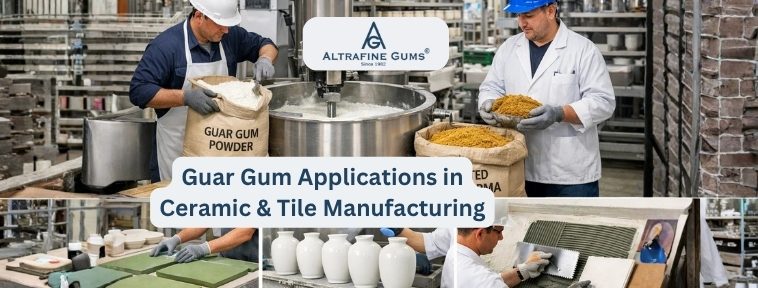
The Use of Guar Gum in Ceramic and Tile Manufacturing
Table of Contents
AI Summary
Guar gum, derived from the guar plant, is a naturally occurring polysaccharide gaining significant traction in ceramic and tile manufacturing due to its multifunctional role as a binder, viscosity modifier and adhesion enhancer. Guar gum powder improves the structural integrity of ceramic bodies during green-stage processing, regulates glaze consistency for uniform application and reduces excess moisture in ceramic pastes to enhance firing efficiency. In tile adhesive formulations, it delivers superior bonding strength while remaining fully biodegradable and non-toxic. Roasted guar korma, a processed derivative, adds further functional value in select industrial applications. Economically, guar powder offers a cost-competitive alternative to synthetic additives, making it a smart choice for manufacturers seeking both performance and sustainability.
Guar Powder as a Binder in Ceramic and Tile Production
In ceramic manufacturing, achieving a consistent and workable body is the foundation of quality output. Guar gum functions as a natural binder that holds raw ceramic particles together during the green (unfired) stage, providing the necessary strength to withstand handling and shaping without cracking or crumbling. Unlike synthetic binders, guar gum powder is water-soluble and integrates seamlessly into the ceramic mix, distributing uniformly at even low concentrations.
The binding action of guar powder derives from its high molecular weight and the ability of its galactomannan chains to form hydrogen bonds with mineral surfaces. This creates a cohesive matrix within the ceramic body, improving both plasticity and green strength. In tile production specifically, this translates into tiles that retain their shape during drying and pre-firing handling – reducing breakage rates and material wastage on the production line. The improved workability also allows manufacturers to achieve finer surface finishes and more precise dimensions.
 Email Us Today!
Impact of Guar Gum on Ceramic Glaze Viscosity
Glaze application is a technically demanding step in ceramic production. The glaze must flow smoothly over the ceramic surface, adhere without dripping and dry uniformly to produce a defect-free finish. Guar gum is widely used to regulate the viscosity of ceramic glazes, ensuring they maintain the right consistency throughout dipping, spraying or brushing operations.
When added in controlled quantities, guar gum powder creates a stable, pseudoplastic suspension – meaning the glaze flows easily under the shear stress of application but thickens again when left undisturbed. This prevents settling of heavier glaze particles, maintains batch consistency and ensures even coverage across tile surfaces. The result is fewer surface defects such as pinholes, crawling or uneven colour distribution after firing. Compared to other rheology modifiers, guar gum is cost-efficient and requires minimal adjustment to existing glaze recipes.
Read Our Article
How Guar Gum Powder is Revolutionizing the Water Treatment Industry?Enhancing Tile Adhesion with Guar Gum Powder
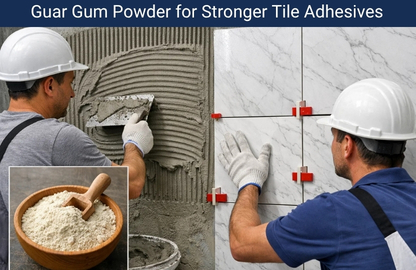
Tile adhesives must deliver reliable bonding across a wide range of substrates – from concrete floors to gypsum walls – while accommodating thermal expansion, moisture fluctuation and structural movement. Guar gum powder plays a critical role in improving the open time and sag resistance of tile adhesive formulations, both of which directly influence on-site installation quality.
Open time refers to the window within which a tile can be pressed into the adhesive and still achieve a proper bond. Guar gum extends this window by slowing moisture loss from the adhesive surface, giving installers more time to position and adjust tiles accurately. Its water-retention properties also ensure that cement-based adhesives hydrate fully, achieving maximum bonding strength. In vertical applications, guar gum’s thickening action prevents tiles from slipping before the adhesive sets. This combination of improved wettability, water retention and sag resistance makes guar gum an essential functional ingredient in high-performance tile adhesive systems.
Guar Gum’s Role in Reducing Water Content in Ceramic Paste
Water management in ceramic paste preparation is critical. Too much water weakens the green body and extends drying time; too little makes the paste stiff and difficult to shape. Guar gum helps manufacturers strike the right balance by acting as a water-binding agent – its hydrophilic structure absorbs and holds water molecules within the paste, reducing the total water required while maintaining workable consistency.
By controlling moisture distribution within the ceramic body, guar gum minimises differential drying – a common cause of warping and cracking during the drying phase. A more uniform moisture profile also means more predictable shrinkage during firing, leading to better dimensional accuracy in the finished ceramic product. For industrial tile producers working to tight tolerances, this improvement in process control translates directly into lower rejection rates and more consistent quality across batches. Roasted guar korma, processed to reduce raw odour and fine-tune viscosity, is used in some advanced paste formulations for this purpose.
Our Other Product
Cassia Tora PowderEnvironmental Benefits of Using Guar Gum Powder in Ceramic Manufacturing
Sustainability is an increasing priority for manufacturers worldwide and guar gum powder offers a compelling eco-friendly profile. It leaves no toxic residues in the ceramic body after firing and unlike some synthetic polymer binders, it does not release harmful volatile organic compounds (VOCs) during the burn-out stage of the firing cycle.
The cultivation of guar is also relatively resource-efficient – the guar plant is drought-resistant and grows in arid semi-arid regions with minimal agricultural inputs, contributing to lower land use impact compared to petrochemical raw materials. For ceramic and tile manufacturers seeking to reduce their environmental footprint, replace synthetic additives or qualify products for green building certifications, guar gum powder is an attractive substitute. Its natural origin also aligns with increasing regulatory pressure in Europe and other regions to reduce synthetic polymer use in construction materials.
Cost-Effectiveness of Guar Gum in Tile Manufacturing
Beyond performance, guar powder delivers strong economic value in tile manufacturing. India is the world’s largest producer and exporter of guar, making guar gum powder readily available at competitive prices compared to synthetic alternatives such as hydroxyethyl cellulose (HEC) or polyvinyl alcohol (PVA). This supply chain stability gives manufacturers reliable access to the ingredient without exposure to the price volatility that often affects petrochemical-based additives.
Its multifunctional nature also means it can replace two or more additives in a single formulation, further reducing formulation complexity and cost. For smaller tile manufacturers in developing markets, the local availability and affordability of guar powder make it an especially practical choice. Overall, guar gum strikes a rare balance of technical performance, environmental responsibility and economic efficiency that few additives can match.
 Call Us Now!
Conclusion
Guar gum has firmly established itself as a versatile and high-value additive in ceramic and tile manufacturing, delivering measurable benefits across binding, glaze control, adhesion, and moisture management. Its natural origin and biodegradability address the industry’s growing environmental responsibilities without compromising on functional performance. The economic advantage is equally compelling – guar powder and its derivative roasted guar korma are available at competitive prices with a stable supply chain, making them accessible to manufacturers of all scales. As the construction and ceramics industry faces mounting pressure to adopt greener, more cost-efficient raw materials, guar gum stands out as a rare solution that satisfies technical, environmental, and commercial requirements simultaneously. It is not merely an additive but a strategic ingredient that supports quality, sustainability, and profitability across the entire tile and ceramic production process.
FAQs
What is the primary function of guar gum in ceramic manufacturing?
Guar gum acts as a natural binder and viscosity modifier, improving the strength and workability of ceramic bodies during shaping and ensuring uniform glaze application before firing.
How does guar gum powder improve tile adhesive performance?
It extends open time, retains moisture for full cement hydration and increases sag resistance - ensuring tiles bond reliably on both horizontal and vertical surfaces during installation.
What is roasted guar korma and how is it used in ceramics?
Roasted guar korma is a heat-processed guar derivative with reduced raw odour and refined viscosity properties, used in select ceramic paste and adhesive applications requiring more controlled rheological behaviour.
Is guar gum environmentally safe for use in ceramic production?
Yes - guar gum is fully biodegradable and plant-derived, releasing no toxic residues or VOCs during firing, making it an eco-friendly alternative to synthetic binders and rheology modifiers.
At what dosage is guar powder typically used in tile manufacturing?
Guar powder is generally effective by weight of the formulation, making it a highly economical additive that delivers significant functional benefits at minimal dosage levels.

CEO, Altrafine Gums
With over Four decades of expertise in the natural gums and hydrocolloids industry, Ajit Patel leads Altrafine Gums, a globally recognized manufacturer and exporter of Guar Gum Powder, Cassia Tora Powder (Cassia Gum Powder) and other Hydrocolloids. Under his visionary leadership, the company has built a strong reputation for quality, innovation, and reliability across the food, feed, pet feed, pharmaceutical, mining, oil drilling and cosmetic sectors.
Altrafine Gums has been serving global industries for decades with a focus on sustainable sourcing, research-driven production, and stringent quality control. Its wide product portfolio includes Guar Gum Powder, Cassia Tora Powder (Cassia Gum Powder) and other plant-based hydrocolloids that serve as key functional ingredients in diverse applications.
Ajit Patel’s commitment to excellence ensures that every product from Altrafine meets international standards of performance and purity. He is passionate about advancing the global reach of Indian hydrocolloids, fostering customer trust, and promoting eco-friendly, science-backed solutions that enhance product formulation and performance worldwide.