





Guar Gum Powder for Clean-Label Foods: Why Manufacturers are shifting to Synthetic Thickeners in 2026
Table of Contents
Guar Gum Powder and the 2026 Clean-Label Paradox in Processed Foods
In 2026, the food industry finds itself in a tug-of-war between two powerful forces: clean-label marketing and the hard realities of food production. Guar Gum Powder, long favored for its natural origin and consumer-friendly label appeal, is now at the center of this paradox. On one hand, marketers love that guar is plant-derived, recognizable and non-synthetic – three powerful selling points in today’s label-conscious market. On the other hand, production teams wrestle with its variability, unpredictable performance in some settings and difficulties during high-speed processing.
The problem lies in what brands want consumers to see versus what they need in the manufacturing process. A food label that reads “natural thickener” reassures shoppers, but inconsistent hydration, batch-to-batch performance fluctuations and process interruptions can cost a company millions. As a result, some manufacturers are quietly phasing out Guar Powder, not because it lacks appeal, but because it complicates operations. In short, Guar Gum remains a darling of the clean-label movement but increasingly a headache on the factory floor.
This paradox sets the stage for deeper exploration into why synthetic thickeners – once taboo – are being reconsidered in 2026, not just for performance, but for their role in preserving product and brand consistency.
Guar Gum Powder Versus Synthetic Thickeners in 2026 Formulation Decisions
When it comes to food formulation in 2026, it’s no longer just about the ingredient’s origin – it’s about how it behaves under stress. Guar Gum Powder, despite its long history of use, is now being directly compared to synthetic thickeners like modified starches, cellulose derivatives and engineered gums. Why? Because manufacturers are prioritizing stability, predictability and efficiency.
Formulators are expected to produce consistent textures, stable suspensions and reliable mouthfeel – even under extreme manufacturing conditions. Synthetic thickeners often outperform natural thickeners in these areas. Guar Gum, while versatile, doesn’t always hold up under high temperatures or in highly acidic environments. Even High-Quality Guar Gum Powder may vary slightly in viscosity or hydration time based on origin, processing methods or even harvest conditions.
In 2026, the formulation conversation is driven by performance under pressure. If a product fails to meet texture standards due to thickener variability, it may be pulled off shelves. That’s a risk many producers can’t afford to take. The outcome? A gradual shift from “natural at all costs” to “predictable performance” even if it involves synthetic options.
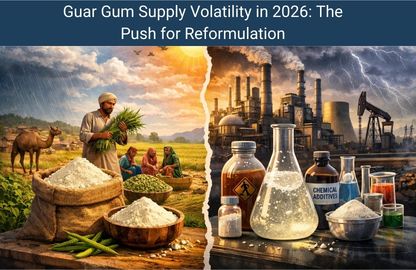
Guar Gum Powder Supply Volatility in 2026 and How It Pushes Reformulation
Guar Gum’s reliance on a limited geographic supply chain continues to be a major liability in 2026. Mostly cultivated in India and Pakistan, guar crops are vulnerable to fluctuating weather patterns, inconsistent yields and geopolitical disruptions. This year, several manufacturers have faced delays or quality inconsistencies due to erratic harvests or exporter bottlenecks.
These supply chain concerns push R&D teams to rethink their reliance on guar gum powder. While price remains a concern, the bigger worry in 2026 is availability and consistency. Reformulating away from guar, even partially, offers a buffer against this unpredictability. Some brands are blending high performance guar gum with synthetics, while others are completely replacing it with engineered stabilizers that guarantee year-round availability.
Sourcing managers now factor in not just cost per kilo but the cost of risk – missed delivery timelines, reformulation under duress or even shelf-space penalties from retailers due to out-of-stock products. Reformulating away from Guar Powder becomes a form of supply chain insurance in a volatile global market.
Guar Gum Powder Performance Challenges in 2026 High-Heat and High-Shear Processing
One of the biggest knocks against Guar Gum in 2026? Its tendency to break down or clump under extreme processing conditions. High-heat cooking, ultra-pasteurization or high-shear mixing environments – common in modern food manufacturing – can all reveal guar’s weaknesses.
In dairy products, sauces or bakery applications that demand smooth textures and heat stability, Guar Gum Powder may lose viscosity or create inconsistent textures. Even with High-Quality Guar Gum Powder, the variation in granule size, hydration rates or pH tolerance can frustrate processing engineers. On the other hand, synthetic thickeners are custom-designed to withstand these exact conditions.
What happens when a vat of soup gels inconsistently or a yogurt batch separates on the shelf? You get rework, waste and downtime – all of which are expensive. That’s why more processors in 2026 are considering high-performance thickeners that work with aggressive processing parameters rather than fighting against them.
Guar Gum Powder Clean-Label in 2026 and the Label Language Problem
Labeling has never been more political or more inconsistent than it is in 2026. Consumers want “clean-label” products, but what that means varies wildly depending on geography, regulation and even retailer policy. Guar gum powder is often allowed under clean-label criteria, but not always. In the EU, certain product categories accept it freely; in parts of the US, some natural food retailers reject it for sounding too industrial.
This inconsistency creates headaches for multinational food brands. They need one product formula that can be sold across several markets – without triggering label warnings or consumer distrust. Unfortunately, Guar Gum’s classification remains a grey area. It’s technically natural but sounds synthetic to some consumers.
Some companies have found that switching to a simplified label – like “plant-based thickener” or “modified fiber” – gives them more flexibility, especially when synthetic thickeners can be engineered to pass label requirements through strategic phrasing.
Guar Gum Powder: Cost-In-Use in 2026 Compared to Synthetic Thickeners
When food manufacturers evaluate ingredients in 2026, they’re not just looking at the price per kilogram – they’re calculating cost-in-use. This term refers to how much of an ingredient is required to achieve the desired result and what hidden costs – like waste, rework and production delays – come with it. Guar Gum Powder, while inexpensive on paper, can turn costly in practice if it leads to inconsistent results or equipment issues.
Let’s say you’re using a batch of Guar Powder that thickens slightly slower or faster than expected. It might hydrate unevenly, clump during mixing or vary in viscosity. What happens next? You either discard the batch, spend time correcting it or accept quality variations – all of which hit your bottom line.
In contrast, synthetic thickeners are engineered for uniform performance. A synthetic stabilizer might cost more up front, but if it guarantees the same result every time, the manufacturer saves on operational costs – less training, fewer mistakes, faster production and fewer rejected batches. That’s why cost-in-use analysis in 2026 often favors synthetics, especially in high-volume production where consistency is king.
Food manufacturers now use predictive models to calculate not just ingredient efficiency, but also the long-term cost of variability – and guar’s inconsistency sometimes makes it a more expensive choice than it appears.
Guar Gum Powder Quality Consistency in 2026 and Why Manufacturers Want Repeatability
The biggest non-negotiable in modern food production? Repeatability. Every bottle, pouch or tub on the shelf needs to look, feel and taste exactly the same as the last one. This kind of precision is tough to achieve when the core thickening agent – like Guar Gum Powder – comes with natural variation.
Even High-Quality Guar Gum Powder, sourced from the same region, can show subtle shifts from batch to batch. The gum content, hydration rate, microbial load or ash content can differ, especially if suppliers aren’t tightly regulated or if environmental conditions change during crop growth. These variations might seem minor on paper but can wreak havoc in sensitive formulations like sauces, frozen desserts or emulsified products.
Synthetic thickeners, on the other hand, are built for precision. Manufacturers can specify exact functional targets – viscosity, solubility, pH tolerance – and receive ingredients that match those specs every time. This reliability makes synthetics incredibly attractive for food brands trying to scale across markets or automate production processes.
In 2026, more producers are documenting quality consistency as a critical control point and guar’s natural unpredictability is getting flagged more often. That’s why many are shifting to ingredients that come with a certificate of performance, not just a certificate of origin.
FAQs
Why are food manufacturers moving away from Guar Gum Powder in 2026?
Because despite its clean-label appeal, Guar Gum shows inconsistent performance during high-speed and high-heat processing, causing production issues.
How does Guar Gum Powder compare to synthetic thickeners in cost?
While cheaper by weight, Guar Powder can be more expensive overall due to variability, waste and rework, making synthetics more cost-effective long-term.
What supply challenges are affecting Guar Gum Powder in 2026?
Its dependence on limited regions leads to supply volatility, weather-related crop risks and geopolitical uncertainties.
Can Guar Gum still be used in clean-label products in 2026?
Yes, but inconsistencies in clean-label definitions across markets make it challenging to maintain global label compliance.
Is high performance guar gum a viable alternative to synthetics?
Yes, it offers improved stability and processing benefits while maintaining a natural label claim, acting as a middle ground solution.

CEO, Altrafine Gums
With over Four decades of expertise in the natural gums and hydrocolloids industry, Ajit Patel leads Altrafine Gums, a globally recognized manufacturer and exporter of Guar Gum Powder, Cassia Tora Powder (Cassia Gum Powder) and other Hydrocolloids. Under his visionary leadership, the company has built a strong reputation for quality, innovation, and reliability across the food, feed, pet feed, pharmaceutical, mining, oil drilling and cosmetic sectors.
Altrafine Gums has been serving global industries for decades with a focus on sustainable sourcing, research-driven production, and stringent quality control. Its wide product portfolio includes Guar Gum Powder, Cassia Tora Powder (Cassia Gum Powder) and other plant-based hydrocolloids that serve as key functional ingredients in diverse applications.
Ajit Patel’s commitment to excellence ensures that every product from Altrafine meets international standards of performance and purity. He is passionate about advancing the global reach of Indian hydrocolloids, fostering customer trust, and promoting eco-friendly, science-backed solutions that enhance product formulation and performance worldwide.