



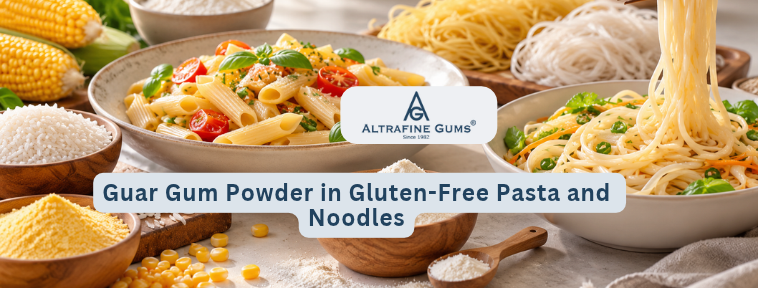
Guar Gum Powder in Gluten-Free Pasta and Noodles
Table of Contents
AI Summary
This article explains how guar gum powder is used in gluten-free pasta and noodles to restore elasticity, bite and cooking stability. It covers the challenges of gluten-free formulation, how guar gum improves structure and binding, its impact on cooking quality, correct usage, and why it suits clean label positioning. The result is a detailed, practical guide for gluten-free food manufacturers and guar gum suppliers.
The Challenge of Gluten-Free Pasta and Noodles
Pasta and noodles traditionally rely on gluten, the protein network in wheat that gives dough its elasticity, strength and characteristic bite. When wheat is removed to make gluten-free products, this network disappears, and formulations based on rice, corn, or other gluten-free flours often struggle to hold together.
The result can be pasta and noodles that are fragile, sticky or prone to falling apart during cooking. To overcome this, manufacturers turn to functional ingredients that can mimic some of gluten’s properties, and guar gum powder is one of the most effective and widely used solutions.
This challenge has grown more important as the gluten-free market has expanded. Consumers who buy gluten-free pasta and noodles increasingly expect them to match conventional products in taste and texture, not simply to be free from gluten. Meeting that expectation depends heavily on the functional ingredients used to rebuild structure, which is why guar gum has become so widely adopted.
The Role of Guar Gum in Gluten-Free Formulations
Guar gum powder is a galactomannan that builds viscosity and binds water strongly, even at low usage levels. In gluten-free pasta and noodles, it helps create structure and cohesion, holding the dough together and improving its ability to be shaped and processed.
By improving binding and elasticity, guar gum allows gluten-free dough to behave more like traditional wheat dough during mixing, sheeting and forming. This makes production smoother and helps manufacturers achieve a product that holds its shape and resists breakage.
Because guar gum works at low usage levels, it delivers these benefits without significantly changing the flavor or nutritional profile of the product. This is valuable in gluten-free formulation, where developers are already balancing several alternative flours and ingredients and need each addition to earn its place in the recipe.
Improving Dough Handling and Production
Gluten-free doughs can be difficult to work with, often being crumbly or lacking the stretch needed for extrusion and shaping. Guar gum powder improves dough handling by adding cohesion and flexibility, which helps the dough move through production equipment more reliably.
This improved workability reduces waste and production problems, allowing manufacturers to make gluten-free pasta and noodles more efficiently. A dough that holds together well also produces a more uniform, higher-quality finished product.
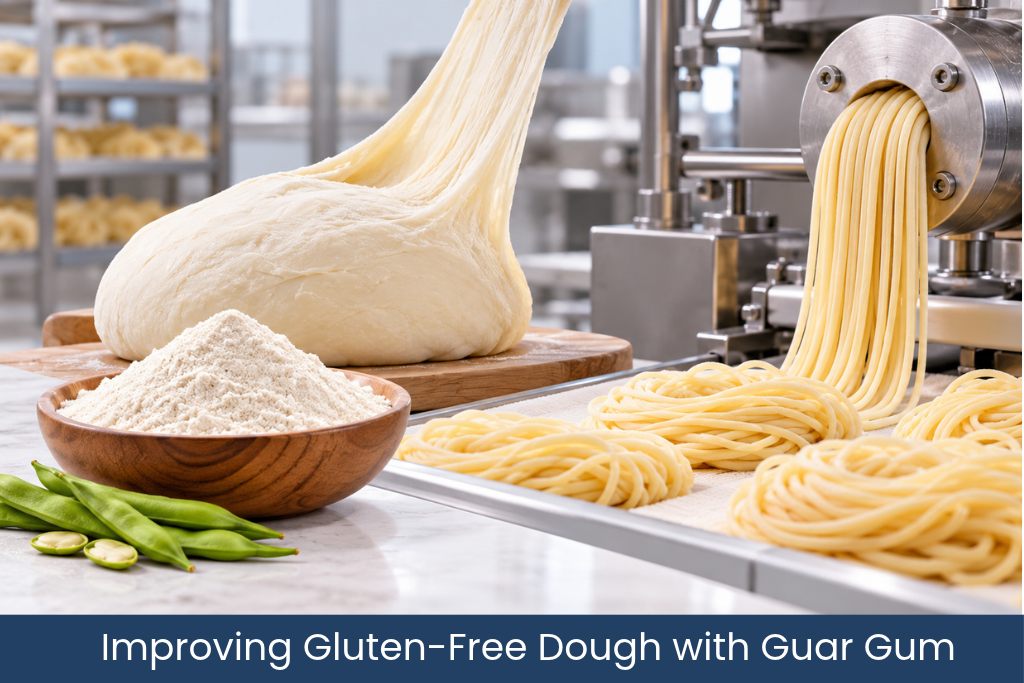
Consistent dough behavior is also important for automated production lines, which rely on predictable handling to run smoothly. By giving gluten-free dough more cohesion and flexibility, guar gum powder helps manufacturers maintain steady, efficient production and reduce downtime caused by dough that tears or sticks.
Guar Gum’s Impact on Cooking Quality
The real test of pasta and noodles comes during cooking. Gluten-free products often become sticky, lose firmness or break apart in boiling water. Guar gum powder helps address these issues by strengthening the structure and reducing stickiness.
By binding water and reinforcing the matrix, guar gum helps gluten-free pasta and noodles maintain firmness and a pleasant bite after cooking. It also helps the product hold its shape and resist breakage during boiling, giving a result much closer to conventional pasta.
Cooking loss is another consideration. Gluten-free pasta can release excess starch into the cooking water, leaving it cloudy and the pasta surface gummy. By strengthening the structure and binding the matrix, guar gum powder helps reduce this effect, producing cleaner cooking water and a more pleasant surface texture on the finished pasta.
Texture and Eating Quality
Beyond holding together, gluten-free pasta and noodles must deliver a satisfying eating experience. Consumers expect a firm, elastic bite rather than a soft or mushy texture. Guar gum powder contributes to this by improving the overall structure and mouthfeel.
The improved texture makes gluten-free products more appealing and more comparable to their wheat-based equivalents. This is important in a competitive market where eating quality strongly influences whether consumers buy a product again.
Texture also affects how versatile a product is in the kitchen. Pasta and noodles that hold their structure can be reheated, baked or stir-fried without falling apart, which widens their appeal. By improving structural integrity, guar gum helps gluten-free products perform across a range of cooking methods, not just when freshly boiled.
Advantages of Guar Gum for Gluten-Free Manufacturers
Guar gum powder is a natural, plant-derived, clean label ingredient, which fits well with the health-focused positioning of many gluten-free brands. It is effective at low usage levels, so it delivers strong functionality without dominating the formulation or the label.
It is also cost-effective and works well in combination with other ingredients. Gluten-free formulations often use guar gum alongside other hydrocolloids such as xanthan gum to fine-tune elasticity and structure, giving developers flexibility to optimize each product.
This ability to work within a blend is a practical advantage. No single ingredient fully replaces gluten, so developers typically build a system in which guar gum contributes binding and structure while other hydrocolloids add elasticity. Adjusting the balance lets them tailor the texture precisely to the product, whether a delicate noodle or a firmer pasta shape.
Using Guar Gum Correctly in Production
To get the best results, guar gum powder must be dispersed and hydrated correctly. Because it thickens quickly, it should be evenly blended with the dry flours before liquid is added, which helps avoid lumping and ensures uniform structure throughout the dough.
Dosage depends on the formulation and the target texture, and choosing the right grade and mesh size affects hydration and performance. Guidance from an experienced supplier can help manufacturers optimize the guar gum level and its balance with other ingredients.
Selecting the right grade and mesh size of guar gum powder also affects how smoothly it hydrates and how it performs in the dough, so matching the specification to the process is worthwhile. With the correct grade and proper handling, manufacturers can achieve consistent results across production runs.
The Future of Guar Gum in Gluten-Free Foods
The gluten-free market continues to grow as more consumers choose gluten-free products by necessity or preference, and expectations for quality keep rising. Guar gum powder is well positioned to support this growth across pasta, noodles and other gluten-free foods.
As products become more sophisticated, consistent ingredient performance becomes increasingly important. Working with an experienced guar gum supplier that provides food grade material with certificate backed specifications ensures gluten-free manufacturers can deliver reliable quality as they grow.
About Altrafine Gums
Altrafine Gums is an Ahmedabad based manufacturer, processor and exporter of natural hydrocolloids and gum powders, including guar gum powder, cassia tora powder, fast hydration guar gum powder, tamarind kernel powder, sesbania gum powder, psyllium husk and locust bean gum powder. With modern processing facilities in Gujarat, India and recognized quality certifications, the company supplies food grade and feed grade material to food processors and manufacturers worldwide.
Altrafine Gums offers guar gum powder and other natural gums in consistent, certificate backed specifications, supported by in-house testing and technical guidance. This helps food manufacturers select the right thickening, gelling and stabilizing agents for their formulations and scale production with confidence.
Conclusion
Gluten-free pasta and noodles succeed or fail on structure, bite and cooking stability, and that is exactly where guar gum powder delivers value. As a natural binder and thickener, it helps replace the elasticity and cohesion that gluten would normally provide, improving both dough handling and the finished product.
From reducing stickiness to maintaining firmness and shape during cooking, guar gum helps gluten-free products perform more like their wheat-based counterparts. Used correctly and sourced as consistent, food grade material from an experienced manufacturer, it gives gluten-free manufacturers a reliable, clean label ingredient.
FAQs
Why is guar gum used in gluten-free pasta and noodles?
Guar gum powder replaces some of the elasticity and binding that gluten provides, helping gluten-free dough hold together, improving structure and reducing breakage during production and cooking.
How does guar gum improve cooking quality?
By binding water and reinforcing the matrix, guar gum powder helps gluten-free pasta and noodles stay firm, resist stickiness and hold their shape during boiling, giving a result closer to conventional pasta.
Does guar gum improve the texture of gluten-free pasta?
Yes. Guar gum improves structure and mouthfeel, giving gluten-free pasta and noodles a firmer, more elastic bite rather than a soft or mushy texture.
Can guar gum be combined with xanthan gum?
Yes. Gluten-free formulations often use guar gum powder alongside xanthan gum to fine-tune elasticity and structure, giving developers flexibility to optimize each product.
How should guar gum be added to gluten-free dough?
Guar gum should be evenly blended with the dry flours before liquid is added, to avoid lumping and ensure uniform structure. Dosage depends on the formulation and target texture.
Where can gluten-free manufacturers source guar gum?
Manufacturers should work with an experienced guar gum supplier offering food grade material with consistent, certificate backed specifications and technical support.

CEO, Altrafine Gums
With over Four decades of expertise in the natural gums and hydrocolloids industry, Ajit Patel leads Altrafine Gums, a globally recognized manufacturer and exporter of Guar Gum Powder, Cassia Tora Powder (Cassia Gum Powder) and other Hydrocolloids. Under his visionary leadership, the company has built a strong reputation for quality, innovation, and reliability across the food, feed, pet feed, pharmaceutical, mining, oil drilling and cosmetic sectors.
Altrafine Gums has been serving global industries for decades with a focus on sustainable sourcing, research-driven production, and stringent quality control. Its wide product portfolio includes Guar Gum Powder, Cassia Tora Powder (Cassia Gum Powder) and other plant-based hydrocolloids that serve as key functional ingredients in diverse applications.
Ajit Patel’s commitment to excellence ensures that every product from Altrafine meets international standards of performance and purity. He is passionate about advancing the global reach of Indian hydrocolloids, fostering customer trust, and promoting eco-friendly, science-backed solutions that enhance product formulation and performance worldwide.