





Semi-Refined vs. Refined Cassia Gum: Key Differences and When to Use Each
Table of Contents
AI Summary
Cassia gum – commercially available as cassia gum powder, cassia tora powder and refined cassia gum powder (E427) – is rapidly gaining traction across Central and Eastern European food markets. From Poland’s expanding bakery sector to Hungary’s confectionery industry, from Ukraine’s processed food landscape to Bulgaria’s natural additives push and from the Czech Republic’s snack food innovations to Serbia’s burgeoning organic sector, cassia gum manufacturers and cassia tora suppliers are witnessing unprecedented demand. This article explores the regional dynamics driving adoption, highlights key cassia tora uses across product categories and outlines why food technologists are choosing cassia powder as a cost-effective, clean-label solution. Whether you’re sourcing e427 cassia gum powder for industrial application or evaluating the broader cassia gum market, this comprehensive guide covers every angle.
Semi-Refined vs. Refined Cassia Gum: Key Differences and When to Use Each
The global hydrocolloid industry has long relied on a diverse toolkit of natural gums, starches and plant-based stabilizers. Among the newer entrants making a strong impression is cassia gum – derived from the endosperm of Sennaobtusifolia seeds – which has earned its place alongside xanthan, guar and locust bean gum in the formulator’s arsenal. Yet not all grades are created equal and understanding the distinction between semi-refined and refined cassia gum powder is essential before deployment.
Semi-refined cassia gum retains more of its natural seed-coat proteins and pigments, making it suitable for applications where cost efficiency and moderate viscosity are priorities. It is commonly used in pet food, industrial paper coating and some meat applications. Refined cassia gum powder, by contrast, undergoes extensive purification to remove husks and impurities, resulting in a whiter, odour-neutral powder with significantly higher gel strength when combined with kappa-carrageenan or xanthan gum. This refined form – also designated as cassia gum powder e427 or e427 cassia gum powder under EU food additive regulations – is approved for direct use in human food products.
The regulatory designation matters enormously in European markets. Cassia gum e427 is listed as a permitted food additive under Regulation (EC) No 231/2012, with specific maximum levels set for various food categories. Food manufacturers sourcing cassia powder for human consumption must therefore work with suppliers who can guarantee the refined grade with appropriate documentation. Reputable cassia gum manufacturers provide full specification sheets, Certificates of Analysis and EU compliance paperwork as standard – a non-negotiable requirement for procurement teams in any European country.
When to choose which grade? Semi-refined suits applications where the gum is not directly ingested by humans and where cost reduction is paramount. Refined cassia gum powder is the default choice for bakery fillings, dairy products, processed meats and confectionery. The choice also depends on synergistic blending: refined cassia tora powder forms particularly robust gels with kappa-carrageenan at concentrations as low as 0.1–0.3%, making it highly economical relative to alternatives. This gel-forming synergy is one of the primary reasons cassia gum market growth has outpaced many competing hydrocolloids over the past decade.
 EMAIL US NOW
Cassia Gum’s Growing Role in the Polish Food Processing Industry
Poland is one of Central Europe’s most dynamic food manufacturing hubs, with a bakery and dairy sector that exports to over 50 countries. The country’s food technologists have been increasingly turning to cassia gum powder as a multifunctional ingredient that addresses key formulation challenges: moisture retention in long-shelf-life breads, syneresis control in yoghurts and fresh cheeses and binding efficiency in processed meat applications.
In bakery specifically, cassia tora powder blended with hydroxypropyl methylcellulose (HPMC) or guar gum has shown excellent results in reducing staling rates and improving crumb texture in packaged rye and wheat breads. Polish bakeries producing for supermarket chains require consistent performance batch after batch – a quality that refined cassia gum powder, sourced from reliable cassia tora suppliers, readily delivers. The gum’s ability to hold water during baking without releasing it excessively upon cooling is particularly valued in high-hydration sourdough-style products.
The processed meats sector – a cornerstone of Polish food exports – uses cassia powder primarily as a binder and moisture-retention agent in cooked hams, frankfurters and pâtés. When used in combination with carrageenan, e427 cassia gum powder creates a firm, sliceable texture while significantly reducing fat content, aligning with consumer trends toward leaner products. Polish meat processors have noted reductions in total hydrocolloid usage of up to 15% after switching to cassia-carrageenan blends, delivering meaningful cost savings without quality compromise.
The Rise of Cassia Gum in the Hungarian Confectionery Market
Hungary has a storied tradition in confectionery, from artisanal chocolate to hard-boiled candies and gummy sweets. As the country’s confectionery manufacturers modernise their formulations for cleaner labels and longer shelf lives, cassia gum powder is emerging as a go-to ingredient for texture engineering at competitive cost points.
Gummy confectionery presents some of the most demanding rheological challenges in food production: the gel must set quickly, resist syneresis during storage, maintain elasticity across a range of temperatures and deliver a clean mouthfeel. Cassia tora powder, when blended with kappa-carrageenan, achieves all of these requirements at dosage levels that are considerably lower – and therefore more economical – than gelatin or pectin-only systems. Hungarian confectionery manufacturers sourcing from established cassia gum manufacturers have reported improved production line efficiency due to faster gel setting times.
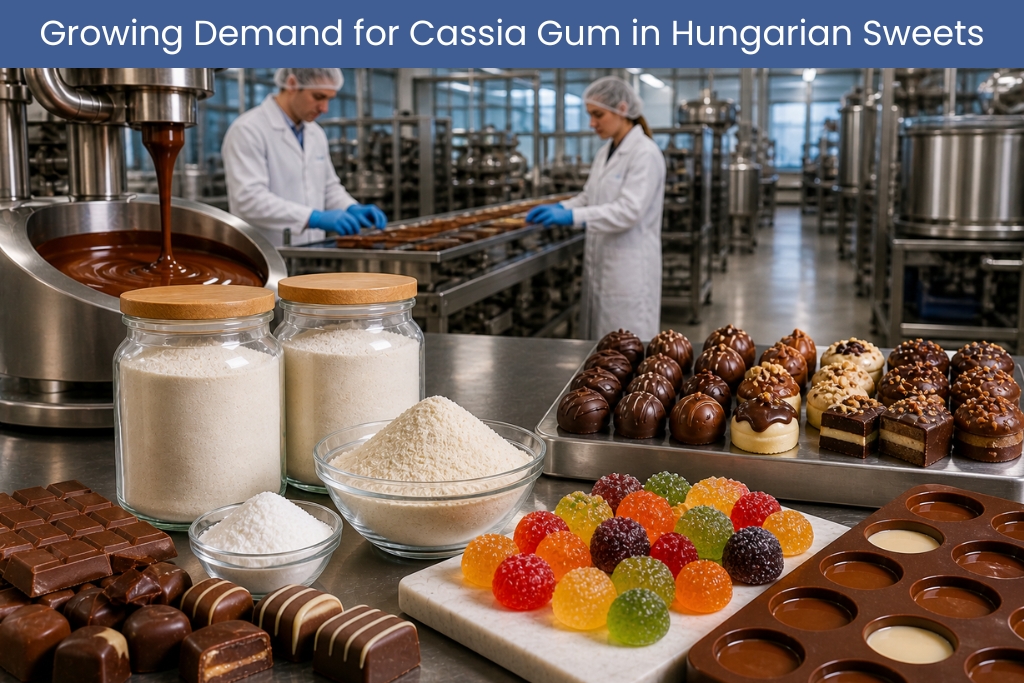
Beyond gummies, cassia powder finds utility in cream fillings, praline coatings and chocolate ganaches where controlled viscosity and temperature stability are needed. The refined grade’s neutral taste profile ensures that it does not interfere with delicate flavour systems – a crucial consideration when working with high-cocoa-content products. The growing cassia gum market in Hungary is further supported by the ingredient’s EU approval status, removing any regulatory hurdles for domestic and export sales alike.
The Potential of Cassia Gum in the Ukrainian Processed Foods Market
Ukraine’s food processing industry, despite significant structural challenges in recent years, is demonstrating remarkable resilience and a forward-looking orientation toward natural, plant-based ingredients. Consumer demand for clean-label products with recognisable ingredient lists has grown substantially, creating an opening for cassia gum powder as a natural stabilizer and thickener in categories ranging from soups and sauces to dairy-based beverages.
Cassia tora uses in Ukraine’s processed food sector are particularly prominent in retort and shelf-stable products, where the gum’s heat stability is a major advantage. Unlike some hydrocolloids that degrade under high-temperature processing, cassia powder maintains its viscosity-building properties through pasteurisation and sterilisation cycles. This makes it ideal for tomato-based sauces, ready meals and canned soups – categories that form a significant portion of Ukrainian retail food sales.
Ukrainian food manufacturers are also exploring cassia gum blends in fermented dairy products such as kefir and drinkable yoghurt, where its synergistic interaction with carrageenan prevents whey separation without making the product overly viscous. As cassia tora suppliers expand their distribution networks into Eastern Europe, Ukrainian buyers benefit from more competitive pricing and improved supply chain reliability, accelerating adoption across mid-sized food processing companies.
Cassia Gum’s Impact on Bulgaria’s Natural Food Additives Market
Bulgaria is experiencing a notable shift in its food additive procurement patterns, driven by consumer pressure for natural, plant-derived ingredients and by EU-wide harmonisation of food safety standards. In this context, cassia gum – positioned at the intersection of natural origin and technological functionality – is gaining significant ground in the Bulgarian market.
Bulgarian food manufacturers, particularly in the dairy and functional food segments, have been replacing synthetic emulsifiers and stabilizers with natural alternatives wherever technically feasible. Refined cassia gum powder fits this requirement precisely: it is derived from a leguminous plant, carries no artificial processing residues and is approved under EU additive regulations as e427 cassia gum powder. Its plant-based origin resonates strongly with Bulgarian consumers who increasingly scrutinise product labels.
The cassia gum market in Bulgaria is also being shaped by the country’s growing export orientation. Bulgarian food exporters targeting Western European markets must comply with demanding retailer specifications that often favour clean-label ingredients. Cassia powder, sourced from reputable cassia gum manufacturers with full traceability documentation, helps Bulgarian producers meet these requirements while maintaining cost competitiveness. Trade fairs and ingredient distributor networks have played a key role in educating Bulgarian food technologists about the full range of cassia tora uses available to them.
Cassia Gum in the Czech Republic: Boosting Quality in Processed Foods
The Czech Republic’s food processing industry is characterised by sophisticated technical standards, a strong export culture and a consumer base with high quality expectations. It is therefore unsurprising that Czech food manufacturers have been among the more technically engaged adopters of cassia gum powder in the region, applying it systematically across bakery and snack food categories.
In bakery, Czech producers of packaged pastries, filled doughnuts and layered cakes have found that cassia tora powder significantly extends moisture retention and reduces the need for artificial humectants. This aligns with Czech consumer preferences for shorter, more recognisable ingredient lists. The gum’s compatibility with fat-reduced formulations is particularly valued as manufacturers respond to health-conscious demand by reducing butter and oil content without sacrificing mouthfeel.
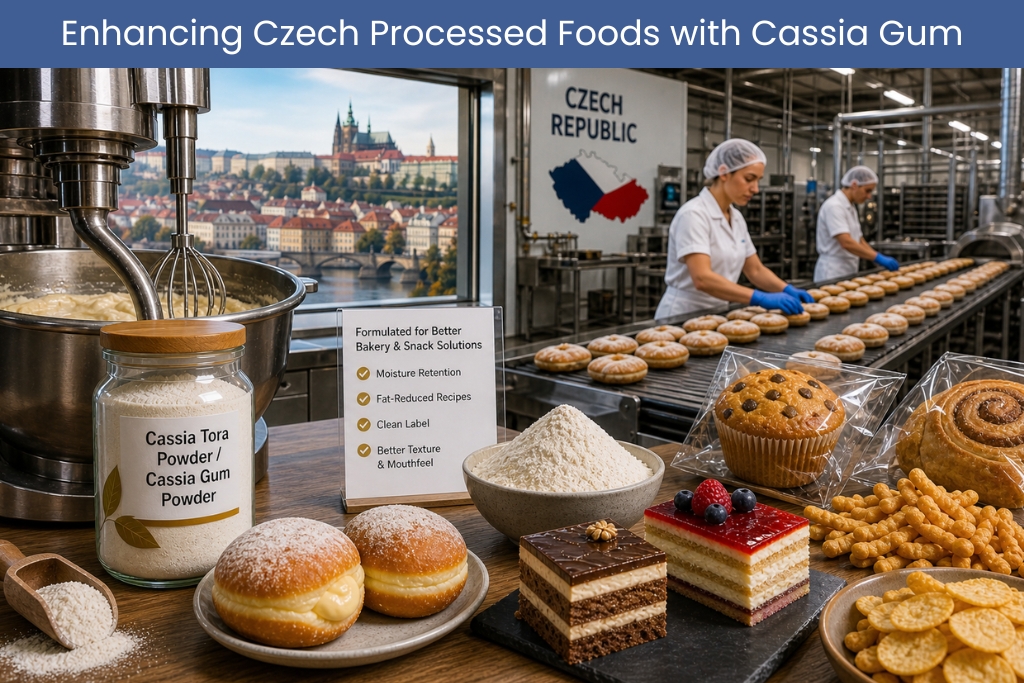
The snack food sector – encompassing extruded snacks, flavoured crackers and popcorn coatings – uses cassia powder as a film-forming and adhesion agent for seasoning blends. When properly dispersed in a coating slurry, refined cassia gum powder creates a uniform, adhesive surface that improves seasoning retention and reduces dust-off during packaging. Czech snack producers working with cassia tora suppliers have reported flavour cost savings as a direct result of improved seasoning transfer efficiency. The broader cassia gum market in the Czech Republic continues to expand as awareness of these performance benefits grows.
The Future of Cassia Gum in Serbia’s Food & Health Sector
Serbia is an emerging market for both organic food production and health-oriented processed foods, with a growing community of entrepreneurs and established companies seeking natural ingredient solutions. Cassia gum is increasingly being positioned within this narrative – not merely as a technical ingredient, but as a marker of product naturalness that resonates with health-conscious Serbian consumers.
The Serbian organic food market, though smaller than its Western European counterparts, is growing at double-digit annual rates. Within this segment, cassia gum powder is being evaluated for use in organic-certified bakery products, plant-based dairy alternatives and health-supplement beverages. Its natural plant origin, combined with its robust functional profile, makes it one of the few hydrocolloids that can simultaneously meet clean-label organic and technical performance requirements.
Cassia tora uses in Serbia are also expanding in the health food channel, where functional beverages, protein shakes and meal replacement products require stable suspension and smooth texture. Cassia powder at low usage levels (0.05–0.15%) can prevent sedimentation and improve pourability in plant-protein beverages without contributing excessive viscosity. As Serbian cassia gum manufacturers and importers build stronger supply relationships, the ingredient’s availability and affordability are expected to improve further, catalysing wider adoption across the food and health sector.
 Call Now
Conclusion
The trajectory of cassia gum across Poland, Hungary, Ukraine, Bulgaria, the Czech Republic and Serbia tells a coherent story: a technically versatile, plant-derived hydrocolloid is steadily displacing less sustainable and more costly alternatives across Central and Eastern Europe’s food processing landscape. Whether deployed as refined cassia gum powder in human food applications under the e427 designation or as semi-refined cassia tora powder in industrial contexts, the ingredient’s combination of functional breadth, regulatory acceptance and supply-chain maturity makes it a compelling choice.
For procurement teams, the key takeaway is to engage with established cassia gum manufacturers who can provide consistent quality, full regulatory documentation and technical support for formulation optimisation. For food technologists, the breadth of cassia tora uses – from gel formation and moisture retention to suspension stabilisation and seasoning adhesion – represents a genuine opportunity to improve product quality while meeting the clean-label demands of today’s European consumers. The cassia gum market across these six countries is still maturing, meaning early movers stand to gain the most from the ingredient’s expanding commercial potential.
FAQs
What is the difference between cassia gum powder and cassia tora powder?
Cassia tora powder refers broadly to powder from Sennaobtusifolia seeds, while cassia gum powder specifically denotes the purified endosperm extract used as a food-grade hydrocolloid.
Is e427 cassia gum powder safe for use in European food products?
Yes - cassia gum powder e427 is an EU-approved food additive under Regulation (EC) No 231/2012, with defined maximum levels for specific food categories.
What are the main cassia tora uses in food manufacturing?
Key cassia tora uses include gelling and texture improvement in confectionery, moisture retention in bakery, stabilisation in dairy products and binding in processed meats.
How do I select reliable cassia tora suppliers for European markets?
Choose cassia tora suppliers who provide Certificates of Analysis, EU compliance documentation, consistent refined-grade specifications and transparent supply chain traceability.
Why is the cassia gum market growing faster than some competing hydrocolloids?
Its synergistic gelling with carrageenan, clean-label plant origin, EU regulatory approval and competitive cost per unit of functionality drive above-average cassia gum market growth.

CEO, Altrafine Gums
With over Four decades of expertise in the natural gums and hydrocolloids industry, Ajit Patel leads Altrafine Gums, a globally recognized manufacturer and exporter of Guar Gum Powder, Cassia Tora Powder (Cassia Gum Powder) and other Hydrocolloids. Under his visionary leadership, the company has built a strong reputation for quality, innovation, and reliability across the food, feed, pet feed, pharmaceutical, mining, oil drilling and cosmetic sectors.
Altrafine Gums has been serving global industries for decades with a focus on sustainable sourcing, research-driven production, and stringent quality control. Its wide product portfolio includes Guar Gum Powder, Cassia Tora Powder (Cassia Gum Powder) and other plant-based hydrocolloids that serve as key functional ingredients in diverse applications.
Ajit Patel’s commitment to excellence ensures that every product from Altrafine meets international standards of performance and purity. He is passionate about advancing the global reach of Indian hydrocolloids, fostering customer trust, and promoting eco-friendly, science-backed solutions that enhance product formulation and performance worldwide.