



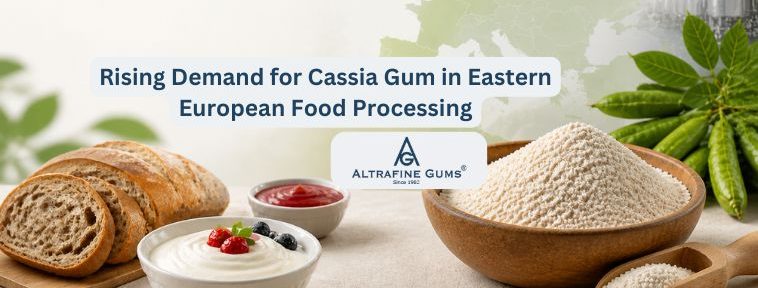
Emerging Market for Cassia Gum in Eastern European Food Processing
Table of Contents
AI Summary
This article explores the rapidly expanding role of cassia gum and cassia gum powder in Eastern European food processing. From its functional advantages over other hydrocolloids to its sustainable sourcing credentials, cassia gum is gaining significant momentum across Poland, Hungary, Romania and beyond. The piece covers health trends, market drivers, competitive comparisons and future growth opportunities – offering a comprehensive view of why cassia tora suppliers and cassia gum manufacturers are increasingly focusing on this dynamic region.
The Growing Demand for Cassia Gum Powder in Eastern Europe’s Food Industry
Eastern Europe’s food processing sector is undergoing a quiet but consequential transformation. As manufacturers across the region seek cleaner, more functional and cost-effective ingredients, cassia gum has emerged as one of the most compelling options in the hydrocolloid space. Derived from the endosperm of Senna obtusifolia seeds, cassia gum powder delivers powerful thickening and gelling properties that are finding increasing relevance in dairy products, meat processing, bakery applications and convenience foods.
The compound is approved under the European food additive designation E427 cassia gum powder (also referenced as cassia gum powder E427), giving it regulatory standing across EU member states in Eastern Europe. As regional processors look for reliable, approved alternatives to synthetic thickeners, the cassia gum market in this part of the world is seeing sustained year-on-year growth – a trend that shows no sign of slowing.
 Email Us Today!
Cassia Gum vs. Other Hydrocolloids in Eastern European Food Manufacturing
Hydrocolloids are the backbone of modern food texture engineering and Eastern European manufacturers have traditionally leaned on guar gum, xanthan gum and carrageenan to achieve desired consistencies in their products. However, refined cassia gum powder is carving out a distinctive position in this competitive landscape.
Unlike guar gum, which can impart a slightly beany aftertaste at higher concentrations, cassia gum is largely flavour-neutral – a meaningful advantage in delicate applications like flavoured dairy desserts or premium meat emulsions. When compared to xanthan gum, cassia tora powder offers superior gel formation when used in combination with carrageenan or locust bean gum, producing firmer, more stable textures at lower use levels. This synergistic gelling behaviour is particularly prized in the production of pet foods, processed meats and low-fat dairy alternatives – all categories seeing strong growth across Eastern Europe.
From a cost perspective, cassia powder also competes favourably. Eastern European food manufacturers operating on tighter margins find it appealing that cassia gum can replace more expensive hydrocolloids without sacrificing technical performance. The result is a compound that wins not just on functionality, but also on economics.
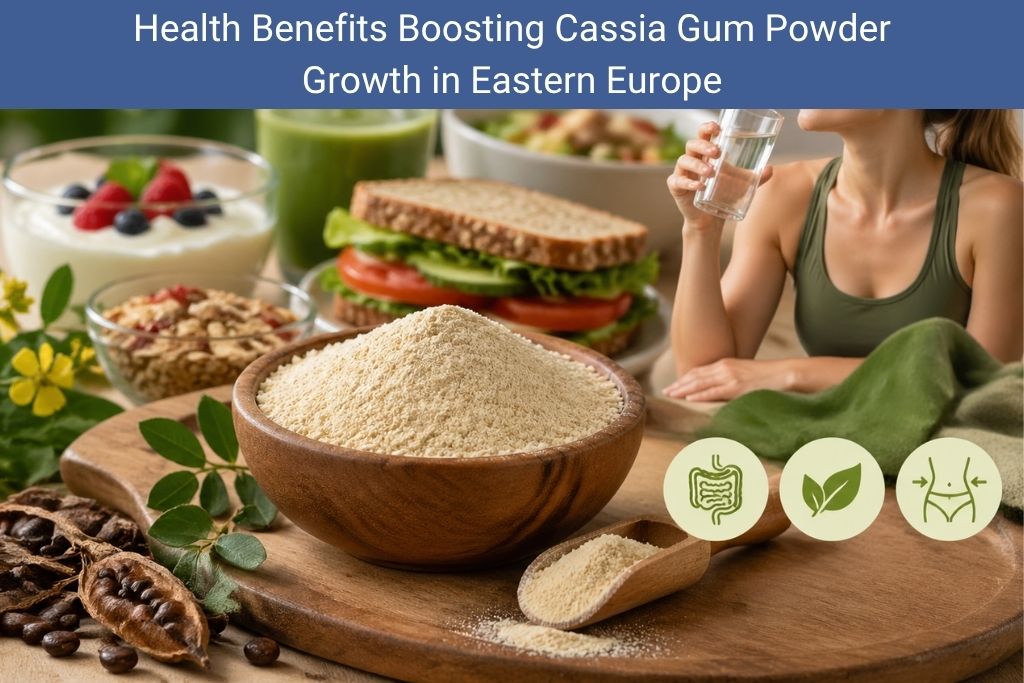
Health Benefits Driving the Growth of Cassia Gum Powder in Eastern European Food Products
One of the most powerful forces reshaping Eastern European food markets is the health-conscious consumer. Urban populations in Poland, the Czech Republic, Hungary and Romania are increasingly scrutinising ingredient labels – and the shift towards natural, plant-derived additives is clearly reflected in procurement strategies across the food industry.
Cassia gum powder aligns naturally with this demand. As a plant-based polysaccharide with dietary fibre properties, it supports digestive health and can contribute to reduced-fat and reduced-calorie formulations by improving mouthfeel and body without adding significant caloric load. Cassia tora uses extend into functional food development, where its prebiotic potential is attracting interest from manufacturers creating gut-health-oriented product lines.
Furthermore, growing consumer awareness around clean-label certification means that ingredients designated as natural and non-GMO carry a distinct marketing premium. Cassia gum fits this profile well and cassia powder uses are expanding accordingly into organic and health-positioned products – from plant-based dairy alternatives to fortified grain products.
Sustainability and Cassia Gum Powder: A Growing Trend in Eastern European Food Processing
Sustainability has moved from a corporate talking point to a genuine procurement criterion across Eastern European food manufacturing. As EU environmental directives tighten and consumers hold brands to higher ecological standards, the sourcing story behind each ingredient matters more than ever.
Cassia (Senna obtusifolia) is a hardy, drought-tolerant crop primarily cultivated in India and parts of East Africa. Its cultivation requires relatively modest water and agrochemical inputs compared to many other hydrocolloid source crops. For manufacturers in the cassia gum market, this translates into a more defensible sustainability narrative – particularly important when pitching to major retail chains or export markets with stringent environmental compliance requirements.
Responsible cassia tora suppliers increasingly provide traceability documentation, third-party certifications and sustainability audit trails that allow Eastern European buyers to meet their own ESG reporting obligations. Cassia gum manufacturers who invest in ethical sourcing and processing transparency are finding particular favour with Polish, German-affiliated and Scandinavian-focused supply chains operating through Eastern European hubs.
Key Countries in Eastern Europe Adopting Cassia Gum Powder for Food Production
While the broader Eastern European region shows promising momentum, certain markets stand out for their pace of cassia gum adoption.
Poland, as the largest food processing economy in Central-Eastern Europe, is a natural leader. Its substantial dairy, meat and confectionery sectors provide broad scope for refined cassia gum powder applications. Polish manufacturers exporting to Western Europe must meet rigorous clean-label and functionality standards, making cassia gum an attractive ingredient upgrade.
Hungary has a well-established tradition in meat and paprika-based processed foods. Here, cassia gum powderis gaining traction as a binder and stabiliser in sausages and pâtés, where its neutral flavour and firm gel properties complement existing formulations without disrupting product identity.
Romania, with its rapidly modernising food processing industry and growing middle-class consumer base, represents one of the highest-growth opportunities in the region. Demand for convenience foods and functional dairy is accelerating and local manufacturers are actively sourcing from cassia tora suppliers to meet new product development briefs.
Other notable markets include the Czech Republic, Slovakia and the Baltic states, where EU regulatory alignment creates a favourable environment for ingredients already carrying E427 approval. In each of these markets, import relationships with Indian cassia gum manufacturers are becoming increasingly formalised.
The Future of Cassia Gum in Eastern European Food Processing: Trends and Opportunities
Looking ahead, several converging trends suggest that the cassia gum market in Eastern Europe is positioned for significant expansion.
The rise of plant-based and vegan food products across the region directly benefits cassia gum, as manufacturers require effective gelling agents free from animal-derived components. Similarly, the growth of functional foods – products designed to deliver measurable health outcomes – expands the relevance of cassia tora powder as a fibre-enriching ingredient.
Innovation in hybrid hydrocolloid systems is another frontier of opportunity. Formulators are discovering that blends of cassia gum with other approved gums produce textures unachievable with single-ingredient systems, opening new possibilities in premium segments like artisan cheese alternatives, plant-based meat analogues and structured desserts.
Finally, digital procurement and direct sourcing relationships are shortening supply chains between Eastern European manufacturers and Indian cassia gum manufacturers, reducing costs and improving ingredient traceability. As these commercial relationships mature, cassia powder uses will continue to diversify – potentially extending into nutraceutical, cosmetic and pharmaceutical applications adjacent to food processing.
 Call Us Now!
Conclusion
Cassia gum’s rise in Eastern European food processing reflects the intersection of several powerful forces: the demand for clean-label functionality, cost efficiency, sustainability and health-positive ingredients. As refined cassia gum powder earns its place alongside more established hydrocolloids, the region’s manufacturers are discovering a versatile, well-regulated and commercially attractive ingredient. For cassia tora suppliers and manufacturers worldwide, Eastern Europe represents not just an emerging market – but a maturing one with real long-term depth.
FAQs
What is cassia gum powder used for in food processing?
Cassia gum powder is used as a thickening, gelling and stabilising agent across dairy, meat, bakery and convenience food applications in Eastern Europe and globally.
Is cassia gum powder E427 approved for use in European food products?
Yes, E427 cassia gum powder holds EU food additive approval, making it legally usable across all EU member states including Eastern European countries.
How does cassia tora powder differ from guar gum?
Cassia tora powder forms firmer gels, is flavour-neutral and performs synergistically with other gums, offering advantages over guar gum in several texture-critical applications.
Where can Eastern European manufacturers source refined cassia gum powder?
Most refined cassia gum powder is sourced from established cassia tora suppliers and cassia gum manufacturers based primarily in India, with increasing direct trade relationships to Eastern Europe.
Why is the cassia gum market growing in Eastern Europe specifically?
Clean-label trends, EU regulatory alignment, plant-based food growth and the push for sustainable ingredients are the primary drivers accelerating cassia gum adoption across the Eastern European food sector.

CEO, Altrafine Gums
With over Four decades of expertise in the natural gums and hydrocolloids industry, Ajit Patel leads Altrafine Gums, a globally recognized manufacturer and exporter of Guar Gum Powder, Cassia Tora Powder (Cassia Gum Powder) and other Hydrocolloids. Under his visionary leadership, the company has built a strong reputation for quality, innovation, and reliability across the food, feed, pet feed, pharmaceutical, mining, oil drilling and cosmetic sectors.
Altrafine Gums has been serving global industries for decades with a focus on sustainable sourcing, research-driven production, and stringent quality control. Its wide product portfolio includes Guar Gum Powder, Cassia Tora Powder (Cassia Gum Powder) and other plant-based hydrocolloids that serve as key functional ingredients in diverse applications.
Ajit Patel’s commitment to excellence ensures that every product from Altrafine meets international standards of performance and purity. He is passionate about advancing the global reach of Indian hydrocolloids, fostering customer trust, and promoting eco-friendly, science-backed solutions that enhance product formulation and performance worldwide.