



Top 5 Challenges in Using Fast Hydration Guar Gum Powder & How to Overcome Them
Table of Contents
Fast Hydration Guar Gum Powder: Uses, Challenges & Solutions
Fast hydration guar gum powder is a widely used industrial additive, especially in applications like oil drilling, mining and hydraulic fracturing. Its rapid viscosity-building capability makes it a preferred thickening, gelling and stabilizing agent. However, users often face practical issues when handling or applying fast hydration guar gum powder in different operational setups. Understanding these challenges and knowing how to resolve them is essential to ensure consistent product performance and operational efficiency.
Let’s take a closer look at the top five challenges that come with using fast hydration guar gum powder and explore the best practices to overcome them effectively.
Fast Hydration Guar Gum Powder Lump Formation during Mixing
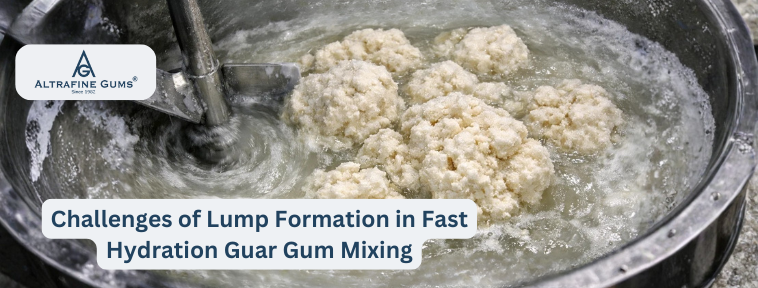
One of the most common challenges encountered when working with fast hydration guar gum powder is lump formation during mixing. When the powder is added too quickly to water, it absorbs moisture almost instantly. This rapid hydration leads to clumping or agglomeration, which makes the mixture uneven and difficult to process.
The problem arises primarily due to the surface of the powder particles absorbing water before the entire volume can be properly dispersed. Once lumps form, they are resistant to full hydration, reducing the effectiveness of the gum in the final solution. These undispersed lumps affect both the viscosity and the stability of the end product.
To prevent this, a few strategies can be employed. The most critical method is slow dosing – gradually adding the guar gum powder into water under constant agitation. Using high-shear mixers or dispersers helps evenly distribute the particles, allowing uniform hydration. Pre-wetting the powder with a small amount of non-aqueous liquid (such as oil or glycol) before adding it to water can also improve dispersion and reduce lump formation.
Another useful technique involves using pre-hydration tanks where guar is first blended in controlled conditions before being transferred to the main process tank. With these methods, users can ensure that the guar gum hydrates evenly and performs optimally.
Fast Hydration Slurriable Guar Gum Viscosity Inconsistency across Batches
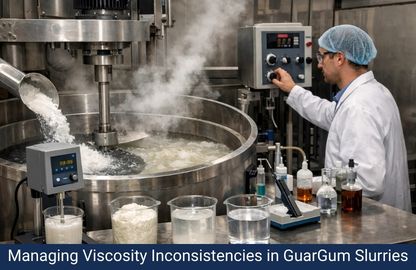
Viscosity inconsistency is another challenge frequently observed when working with fast hydration slurriable guar gum. Batch-to-batch variation can lead to performance discrepancies, especially in applications requiring precise flow properties like fracturing fluids and drilling muds.
Inconsistency in viscosity often results from differences in hydration time, shear rate during mixing, temperature and water chemistry. If these variables are not standardized, the viscosity profile of the slurry will vary each time, making it difficult to maintain process control.
To resolve this issue, it is essential to maintain consistent process parameters. This includes controlling the mixing speed, duration and equipment used for hydration. The use of programmable mixing systems can help in setting uniform shear conditions across batches.
Additionally, suppliers should be chosen carefully to ensure the guar gum powder has consistent particle size distribution and moisture content. Variations in raw material quality can significantly influence how the gum hydrates and thickens.
Establishing standard operating procedures (SOPs) and ensuring operators follow them precisely is crucial. For instance, hydration time should be monitored closely, as insufficient or excessive hydration can skew viscosity results. Regular laboratory testing and batch-to-batch comparisons using viscometers also help track and manage viscosity trends effectively.
Fast Hydration Guar Gum Over-Thickening and Flow Control Issues
Fast hydration guar gum is designed to build viscosity quickly, which is useful in many applications – but this same property can cause problems if the dosage is not accurately controlled. Over-thickening can result in fluids that are too viscous to pump, handle or apply effectively.
This often happens when operators assume that more gum leads to better performance, but in practice, excessive gum leads to waste and operational inefficiencies. In hydraulic fracturing, for instance, too much viscosity can hinder proppant transport and increase pumping costs. In mining, over-thickened slurries can clog pipelines or slow down material flow.
The key to avoiding over-thickening is precise dosing and active viscosity monitoring. This means calculating the correct amount of guar gum powder needed for a particular volume of fluid based on the required final viscosity. Modern dosing systems can automate this process, reducing the likelihood of human error.
Viscosity monitoring tools like inline viscometers or rheometers can provide real-time feedback, allowing operators to make adjustments on the fly. These systems ensure that the hydration process stays within the desired viscosity range, maintaining flowability and performance without unnecessary thickening.
Training personnel to understand the implications of overdosing and establishing strict quality control practices are also important. By fine-tuning the application, users can make the most of fast hydration guar gum without the side effects of over-thickening.
Our Other Product:
Guar Gum PowderFast Hydration Slurriable Guar Gum Powder Sensitivity to Water Quality and pH
Fast hydration guar gum’s performance is directly affected by the quality of the water used for hydration. Factors like dissolved salts, water hardness and pH can significantly alter the hydration rate and final viscosity of the gum solution.
In hard water conditions, calcium and magnesium ions may interfere with the gum’s molecular structure, reducing its ability to swell and develop viscosity. Similarly, a pH level that is too high or too low can hinder optimal hydration. Ideally, the water pH should be maintained between 6.0 and 7.5 for best results.
One way to overcome this challenge is by pre-treating the water before introducing the guar gum powder. This can involve using water softeners or chelating agents to reduce hardness or adding pH adjusters like citric acid or sodium bicarbonate to balance pH levels. Regular water quality testing helps identify issues before they impact the guar gum performance.
In applications like oilfield operations, where water sources may vary, it’s important to monitor water parameters in real-time. Even minor variations in water chemistry can lead to significant differences in viscosity output. Therefore, setting up a water treatment protocol and adjusting hydration parameters accordingly ensures consistent product performance regardless of water source.
Fast Hydration Guar Gum Handling and Dispersion Challenges
Handling and dispersing fast hydration guar gum powder effectively is crucial to its overall performance. Due to its fine particle size and hygroscopic nature, the powder tends to form dust and may absorb ambient moisture if not stored correctly. This can lead to caking, clumping or reduced shelf life.
Improper storage and handling not only reduce efficiency but can also pose safety risks due to airborne dust. Furthermore, if the powder is exposed to moisture before use, it may begin hydrating prematurely, making it difficult to disperse uniformly when added to water.
To manage these issues, it’s recommended to store fast hydration guar gum in moisture-controlled environments, preferably in airtight containers or sealed bags. Warehouses should be cool, dry and free from excessive humidity. Desiccants can be added to storage areas to help maintain dryness.
For feeding the powder into the hydration system, use dust-free feeding mechanisms like screw feeders or vacuum transfer systems that prevent powder loss and improve workplace safety. Some users opt for pre-slurried guar gum solutions, which eliminate dust issues and offer more consistent hydration.
Regular equipment maintenance and operator training further contribute to smooth handling. By controlling environmental factors and investing in proper feeding systems, companies can reduce wastage, improve hydration consistency and enhance the overall application of fast hydration guar gum powder.
Conclusion: Efficient Use of Fast Hydration Guar Gum Powder
Fast hydration guar gum powder is a powerful tool in industries where rapid viscosity development and flow control are essential. However, as with any specialized ingredient, challenges arise – be it in mixing, consistency, over-thickening, sensitivity to water or handling.
Understanding these common issues and applying targeted solutions – like slow dosing, standardized mixing, proper water treatment, precise viscosity control and improved storage – can help industries unlock the full potential of this high-performing additive. With a proactive approach, companies can minimize waste, improve product performance and ensure a safer and more efficient operation.
FAQs About Fast Hydration Guar Gum Powder
Why does fast hydration guar gum form lumps when mixed?
Because it absorbs water rapidly; slow dosing and high-shear mixing help prevent this.
How can I ensure consistent viscosity with fast hydration guar gum?
Standardizing mixing speed, time and water quality ensures uniform viscosity.
What causes over-thickening in guar gum solutions?
Usually, overdosing or improper viscosity control - use exact dosages and monitor.
Does water quality affect fast hydrating guar gum powder performance?
Yes, hardness and pH changes can significantly impact hydration and viscosity.
What's the best way to store fast hydration guar gum powder?
Keep it dry and sealed in a moisture-free, cool environment to maintain quality.

CEO, Altrafine Gums
With over Four decades of expertise in the natural gums and hydrocolloids industry, Ajit Patel leads Altrafine Gums, a globally recognized manufacturer and exporter of Guar Gum Powder, Cassia Tora Powder (Cassia Gum Powder) and other Hydrocolloids. Under his visionary leadership, the company has built a strong reputation for quality, innovation, and reliability across the food, feed, pet feed, pharmaceutical, mining, oil drilling and cosmetic sectors.
Altrafine Gums has been serving global industries for decades with a focus on sustainable sourcing, research-driven production, and stringent quality control. Its wide product portfolio includes Guar Gum Powder, Cassia Tora Powder (Cassia Gum Powder) and other plant-based hydrocolloids that serve as key functional ingredients in diverse applications.
Ajit Patel’s commitment to excellence ensures that every product from Altrafine meets international standards of performance and purity. He is passionate about advancing the global reach of Indian hydrocolloids, fostering customer trust, and promoting eco-friendly, science-backed solutions that enhance product formulation and performance worldwide.