



Understanding the Composition of Guar Gum: Chemical Structure, Functional Components and Industrial Relevance
Table of Contents
Role of Guar Gum in Industry: Key Properties and Composition for Optimal Results
Guar gum is one of the most versatile natural hydrocolloids used across global industries. Extracted from the endosperm of guar seeds, it is valued for its thickening, gelling, stabilizing and water-binding properties. The performance of guar gum in various applications depends largely on its composition and chemical structure. As industries continue to shift toward natural polymers and sustainable alternatives to synthetic additives, understanding the composition of guar gum becomes essential for both manufacturers and buyers. Companies like Altrafine Gums supply standardized and composition-verified guar gum that ensures consistent results across food, feed, cosmetic, pharmaceutical and industrial applications.
Guar Gum Composition: The Key to Optimizing Performance Across Industries
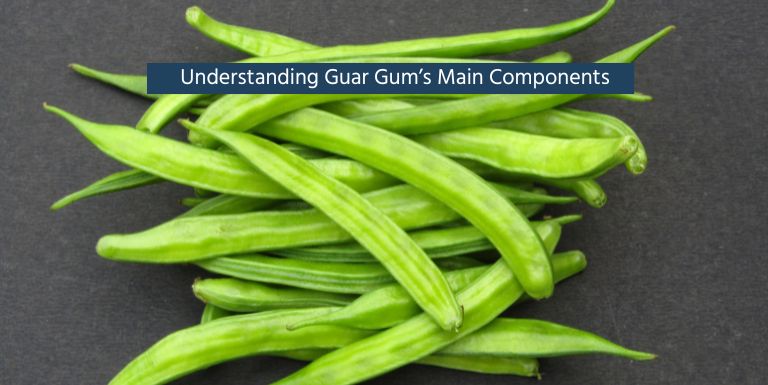
Guar gum originates from the guar plant, a legume cultivated mainly in India. The endosperm of the seed contains high levels of galactomannan polysaccharide, which is the primary functional component. The composition of guar gum influences its viscosity, hydration rate, solubility and overall performance in formulations. Industries analyze guar gum composition to optimize application behavior, ensure quality consistency and meet regulatory requirements.

Chemical Structure of Guar Gum
Guar gum is chemically classified as a galactomannan. This polysaccharide consists of a mannose backbone with galactose side chains. The ratio of mannose to galactose is approximately two to one, which gives the polymer its characteristic solubility and thickening abilities. The linear mannose chain forms the backbone, while galactose units are attached through glycosidic bonds, creating a branched structure.
This arrangement affects hydration, gel formation, viscosity and interaction with water. Compared with locust bean gum, guar gum has more frequent galactose branching, making it hydrate faster and disperse more readily in cold water. Compared with xanthan gum, which has a more complex and rigid molecular structure, guar gum produces a smoother, more neutral viscosity profile suitable for diverse formulations. These structural differences explain why each hydrocolloid performs uniquely in different industrial applications.
Key Components Present in Guar Gum
Guar gum contains several key components that determine its functional properties. The major portion consists of polysaccharides, mainly galactomannans, which are responsible for thickening, stabilizing and water-binding characteristics. These high molecular weight components allow guar gum to generate high viscosity even at low concentrations.
Proteins are present in minor quantities and influence color, solubility and behavior in certain formulations. While not the primary functional component, proteins can affect purity and compatibility in sensitive applications such as pharmaceuticals and cosmetics.
Guar gum also contains dietary fiber, which contributes to water absorption, hydration behaviour and stabilization performance. This fiber content makes guar gum useful in food, nutraceutical and animal feed applications.
Moisture content is another important component, as excessive moisture can affect storage stability and viscosity. Controlled moisture levels ensure consistent quality during transportation and usage.
Ash and mineral content indicate the level of inorganic matter present. Lower ash content is preferred for high purity applications, especially in food and pharmaceuticals. High ash levels may reduce performance in certain industrial processes.
Trace lipids and phytochemicals, while present in very small amounts, can influence emulsification, interaction with oils and overall stability. These natural components can provide mild functional benefits in cosmetic and industrial applications.
Read Our Article: The Requirement of Guar Gum Powder in Oil Mining & Drilling Industries
Physicochemical Properties Influenced by Composition
The composition of guar gum directly affects its physicochemical properties. Viscosity is one of the most critical parameters and is influenced by the molecular weight and purity of the galactomannan. Hydration rate is another key factor, especially in applications where rapid thickening is required. Fast hydration guar gum is preferred in industries such as animal feed and certain industrial processes.
Solubility behavior depends on the structure and degree of branching. Guar gum generally dissolves well in cold water due to its branched galactomannan structure. pH stability allows guar gum to function across a wide range of formulations without degradation. Gel formation capabilities also depend on its composition, especially when interacting with other hydrocolloids. Thermal stability allows guar gum to maintain viscosity under varying heat conditions.
Our Other Product: Fast Hydration Guar Gum Powder
How Composition Affects Functionality?
In the food industry, guar gum functions as a thickener, gelling agent and stabilizer. Its composition enables smooth texture, moisture retention, mouthfeel enhancement and synergy with hydrocolloids such as carrageenan and xanthan gum. The galactomannan structure allows it to stabilize ice creams, sauces, dressings, dairy products, beverages and bakery items.
In pet food and animal feed, guar gum acts as a binder that improves pellet strength and digestibility. Its hydration and fiber content support better feed consistency.
In cosmetics and personal care products, guar gum improves texture, enhances glide, stabilizes formulations and forms a smooth, non-greasy film on the skin. Its composition supports compatibility with botanical extracts, essential oils and surfactants.
In pharmaceutical and nutraceutical applications, guar gum functions as a tablet binder, disintegrant and controlled-release agent. Its ability to swell and form gels directly relates to its composition.
Industrial sectors also rely on guar gum’s functional properties. In mining, its flocculation ability helps separate solids from liquids. In textiles, guar gum derivatives are used as printing thickeners. In the paper industry, it enhances sheet strength and surface finish.
Grades of Guar Gum and Composition Differences
Guar gum is available in different grades, and composition can vary based on processing. Food grade guar gum is highly purified with controlled microbial and ash content. Industrial grade guar gum may contain higher levels of impurities but offers excellent functionality for textiles, paper and mining.
Fast hydration guar gum hydrates rapidly and is suitable for animal feed and processes that require immediate viscosity. Purified or refined guar gum offers higher quality, while technical guar gum is used for industrial applications where purity requirements are lower.
Read Our Article: Guar Gum Powder: An Essential Ingredient for Australia’s Food, Pet Food, and Mining Industries
Factors Affecting Guar Gum Composition
Composition can vary depending on seed quality, climate, soil conditions and crop maturity. Processing techniques including husking, splitting and grinding also affect purity and molecular structure. Screening methods help achieve consistent particle size and mesh distribution. Storage conditions, especially in humid environments, can influence moisture levels and performance.
Testing Parameters to Determine Composition
Standard testing helps determine the composition and quality of guar gum. Viscosity testing using Brookfield viscometers is one of the most important evaluations. Particle size distribution determines mesh grade and affects solubility. Protein, moisture and ash analysis reveal purity levels. Microbial testing ensures safety for food and pharmaceutical applications. Color and odor testing help evaluate physical quality and batch uniformity.

Why Composition Matters for Global Buyers?
The composition of guar gum has a direct impact on performance in end-use applications. Consistency is essential for large-scale production in food, feed and cosmetics. Global buyers must ensure that the guar gum they procure meets regulatory standards and formulation requirements. Companies that rely on guar gum for high-quality products must choose suppliers that provide composition-verified and fully tested material. Altrafine Gums is known for supplying premium guar gum with strict quality control, ensuring reliability for diverse industries.
Our Other Product: Cassia Tora Powder
Guar Gum Composition in Achieving Consistent Performance Across Industries
Guar gum’s composition, particularly its galactomannan structure, fiber content, protein levels and moisture balance, plays a significant role in determining its functionality. Understanding these components helps industries select the right grade for their applications. From food and feed to cosmetics, pharmaceuticals and industrial processes, guar gum continues to be a valuable natural hydrocolloid. As global demand increases, sourcing high quality, composition-verified guar gum from reliable manufacturers like Altrafine Gums becomes essential for maintaining product performance and consistency.
Frequently Asked Questions About Guar Gum Composition
What is the main chemical component of guar gum?
Guar gum is primarily composed of galactomannan, a polysaccharide made from mannose and galactose units.
Why is the mannose to galactose ratio important?
The two to one ratio determines solubility, hydration behavior and viscosity, which influence its performance in food, cosmetics and industrial applications.
Does the protein content in guar gum affect quality?
Protein levels can influence color, solubility and purity, especially in food and pharmaceutical uses.
What is the ideal moisture content in high quality guar gum?
Guar gum typically contains controlled moisture to ensure stability. Excess moisture can reduce shelf life and affect viscosity.
How is guar gum composition tested?
Viscosity testing, mesh analysis, protein and ash evaluation, microbial testing and physical inspection are commonly used.
Why does guar gum perform better than some other hydrocolloids?
Its galactomannan structure allows high viscosity at low dosage, fast hydration, good solubility and compatibility across various applications.
Do different grades of guar gum have different compositions?
Yes, food grade, industrial grade and fast hydration guar gum have variations in purity, hydration rate and ash content.

CEO, Altrafine Gums
With over Four decades of expertise in the natural gums and hydrocolloids industry, Ajit Patel leads Altrafine Gums, a globally recognized manufacturer and exporter of Guar Gum Powder, Cassia Tora Powder (Cassia Gum Powder) and other Hydrocolloids. Under his visionary leadership, the company has built a strong reputation for quality, innovation, and reliability across the food, feed, pet feed, pharmaceutical, mining, oil drilling and cosmetic sectors.
Altrafine Gums has been serving global industries for decades with a focus on sustainable sourcing, research-driven production, and stringent quality control. Its wide product portfolio includes Guar Gum Powder, Cassia Tora Powder (Cassia Gum Powder) and other plant-based hydrocolloids that serve as key functional ingredients in diverse applications.
Ajit Patel’s commitment to excellence ensures that every product from Altrafine meets international standards of performance and purity. He is passionate about advancing the global reach of Indian hydrocolloids, fostering customer trust, and promoting eco-friendly, science-backed solutions that enhance product formulation and performance worldwide.